
Types Of Stainless Steel Material
Hey there, metal lovers and kitchen wizards! Ever gaze lovingly at your gleaming kitchen knives, that shiny pot you swear makes your pasta taste better, or even that super-tough bolt holding your bike together, and wonder, "What is this magical, non-rusty stuff?" Well, buckle up, buttercups, because we're diving into the wonderful world of Stainless Steel! It's basically steel's cooler, more sophisticated cousin who never sweats or rusts, and it comes in more flavors than your favorite ice cream shop.
Think of stainless steel as the superhero of metals. It’s strong, it’s shiny, and it bravely fights off those pesky rust monsters that love to attack regular old steel. This heroic feat is all thanks to a secret ingredient: chromium. When chromium meets oxygen, it forms a super-thin, invisible shield on the surface that’s practically impenetrable to rust and corrosion. It’s like a tiny, personal bodyguard for every atom of steel!
Now, just like there isn't just one type of cookie (thank goodness!), there isn't just one type of stainless steel. They're all superheroes, sure, but they have different powers and specialties. We’re going to explore a few of the big players, the ones you’ll encounter most often in your everyday adventures. So, grab a comfy seat, maybe a snack (something stainless steel-y would be perfect!), and let's get started!
The Most Common Crew: Austenitic Stainless Steels
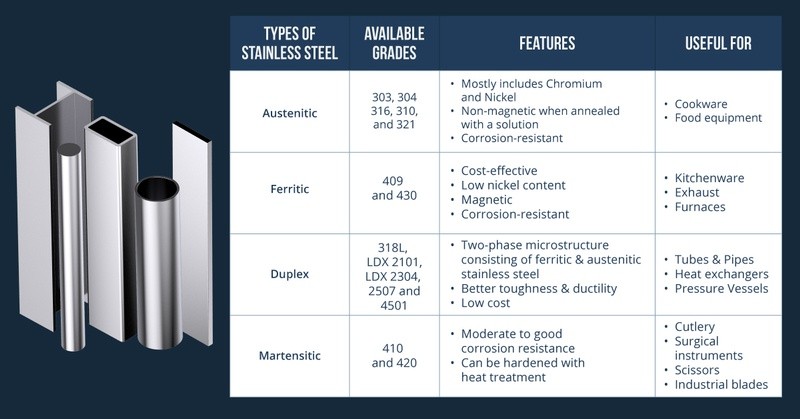
First up, the rockstars of the stainless steel world, the undisputed champions of everyday use: Austenitic stainless steels. These guys are the most widely used, making up about 70% of all stainless steel produced. They’re like the friendly, reliable neighbors who are always there for you, looking good and never causing trouble.
The most famous member of this austenitic family is undoubtedly 304 stainless steel. You know that shiny sink where you do all those dishes? Chances are, it’s 304! That sturdy mixing bowl? Yep, probably 304. It’s incredibly versatile, resisting corrosion like a boss, and it’s easy to work with, which is why manufacturers love it for everything from pots and pans to car trim.
Another well-known sibling in this austenitic crew is 316 stainless steel. Think of 316 as 304’s slightly more adventurous and resilient cousin. It’s got a little something extra – molybdenum – which gives it an even bigger boost in fighting off corrosion, especially from things like salt and acids. This makes 316 the go-to for marine applications (think boat parts that don't rust in the ocean!) and even medical implants, because it’s so trustworthy and biocompatible.
What makes austenitics so special? Well, they have a specific internal structure (hence the fancy name!) that makes them non-magnetic. So, if you’re playing with magnets in your kitchen, your trusty 304 pot won't stick. They're also super formable, meaning they can be bent, shaped, and welded without losing their strength or their good looks. It's like they're made of incredibly strong play-doh!

Why You Love Austenitics (Even If You Didn't Know It!)
These steels are the workhorses that keep our kitchens sparkling and our lives a little bit easier. Imagine a world without them! Your fridge would be a rusty mess, your cutlery would weep tears of iron oxide, and cooking would be a much less enjoyable experience. Thankfully, the austentic superheroes are here to save the day!
Their incredible resistance to rust means you can wash them again and again without them complaining. No more scrubbing away at those orange spots! Plus, they don’t impart any weird flavors to your food, so your delicate cookies taste like cookies, not like a metal factory. It's pure deliciousness, uncompromised!
The Strong and Mighty: Martensitic Stainless Steels
Now, let’s switch gears to a different kind of superhero: the Martensitic stainless steels. These guys are all about strength and hardness. If austenitics are the friendly neighbors, martensitic steels are the super-fit athletes of the metal world. They're tough, they can be made incredibly sharp, and they hold that sharpness like a champ.
The undisputed champion here is 440C stainless steel. This is the stuff of legend for knife enthusiasts. Why? Because it can be heat-treated to achieve an astonishing level of hardness, making it perfect for razor-sharp blades that can slice and dice with incredible precision. Your favorite chef's knife? There’s a good chance it's a marvel of martensitic engineering!

What gives these martensitic steels their edge (pun intended!)? Their crystal structure is different, and when they’re heat-treated, they become super hard. They’re also magnetic, unlike their austenitic cousins. This means your martensitic knife might stick to a magnetic strip on the wall – a handy feature for any kitchen!
Where Martensitic Might Steal the Show
While you might not see martensitic stainless steel in your sink, you’ll find it where durability and edge retention are paramount. Think high-performance tools, surgical instruments, and, of course, those amazing knives. They are designed to withstand demanding tasks and maintain their superior performance over time.
These steels are the unsung heroes behind many everyday tools that require a sharp, reliable edge. They’re the secret weapon in your culinary arsenal, ensuring your ingredients are prepped with ease and precision. The next time you’re chopping onions with a knife that glides through them, give a little nod to the martensitic steel within!
The Clever and Convenient: Ferritic Stainless Steels
Next up, we have the Ferritic stainless steels. These are often seen as a good balance between cost and performance. They are generally less expensive than austenitics but still offer excellent corrosion resistance. Think of them as the sensible, reliable car that gets you where you need to go without any fuss.
A common example is 430 stainless steel. You might find this in your dishwasher door, your oven trim, or even some decorative architectural elements. It’s a good all-rounder, providing decent corrosion resistance for less demanding applications. It’s like the trusty sidekick who is always ready to help out.
Ferritic steels are also magnetic, just like the martensitic ones. Their internal structure is different, making them less formable than austenitics but still quite useful. They offer good resistance to stress corrosion cracking, which is a big plus in certain environments. They’re not as flashy as some of the others, but they get the job done reliably.
The Practical Powerhouses
Ferritic stainless steels are fantastic for applications where you need good corrosion resistance without breaking the bank. They are widely used in automotive exhaust systems, appliance components, and even for cladding buildings. Their affordability makes them a popular choice for many manufacturers.
So, while they might not be the star of your cutlery drawer, these ferritic steels are quietly contributing to the functionality and longevity of many everyday items. They’re the backbone of countless applications, providing that essential protection against rust and wear. A true testament to practical excellence!
The Super Duper Tough Ones: Duplex Stainless Steels
Finally, let's talk about the heavy hitters, the power couple of the stainless steel world: Duplex stainless steels. These guys are a bit of a hybrid, boasting a mix of both austenitic and ferritic structures. This unique combination gives them exceptional strength and corrosion resistance, making them the superheroes of the extreme.

Think of duplex steels as having the best of both worlds. They are significantly stronger than the common austenitic grades, and they also have superior resistance to stress corrosion cracking. This makes them ideal for incredibly demanding environments, like offshore oil rigs, chemical plants, and even bridges.
They get their name because they have a dual phase structure. This microstructural marvel allows them to be both strong and tough, a combination that’s hard to achieve. They are also magnetic, another trait they share with martensitic and ferritic steels.
Where Duplex Steels Shine Brightest
When you need something that can handle extreme pressure, corrosive chemicals, or harsh environmental conditions without flinching, duplex stainless steels are your go-to. They are the silent guardians in industries where failure is not an option. They’re built for the toughest jobs imaginable.
So, next time you see something incredibly robust and gleaming in a challenging environment, remember the amazing duplex stainless steels. They are the unsung heroes working tirelessly behind the scenes, ensuring the safety and integrity of critical infrastructure and industrial processes. Truly the titans of the stainless steel realm!
And there you have it, a whirlwind tour of some of the most common types of stainless steel! From your everyday kitchen sink to the most extreme industrial applications, these versatile metals are quietly making our lives shinier, safer, and a whole lot less rusty. So, give your stainless steel possessions a little nod of appreciation – they’re pretty amazing!