
Weight Calculation Of Steel Pipe
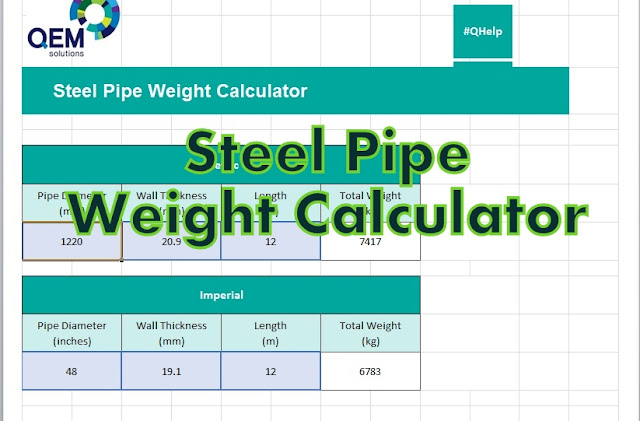
Alright, gather ‘round, folks! Let’s talk about something that sounds about as exciting as watching paint dry, but trust me, it’s got its own quirky charm. We’re diving deep, like a submarine into the Mariana Trench, into the thrilling world of… weight calculation of steel pipe. I know, I know, your eyes are already glazing over. But picture this: you’re at a party, someone asks what you do, and you casually drop, “Oh, you know, I’m an expert in ferrous metal cylindrical volume estimations.” Instant charisma, right? Maybe not. But hey, at least you’ll be the smartest person in the room when it comes to figuring out how much that giant metal tube actually weighs. And isn’t that what life’s all about?
So, why on earth would you need to know how much a steel pipe weighs? Is it for bragging rights at the next DIY convention? Probably not. The real reason is often much more… practical. Think about shipping. You can’t just toss a couple of colossal pipes onto a regular old delivery truck and hope for the best. It’s like trying to fit an elephant into a Mini Cooper – disastrous and probably illegal. Knowing the weight ensures you’re using the right truck, the right crane, and the right amount of sheer, unadulterated muscle (or at least, enough hydraulic power to make muscle jealous).
Then there’s structural integrity. Imagine building a bridge, or a skyscraper, or even just a really, really fancy garden trellis, and the pipes you’re using are secretly lighter than they look. That’s a recipe for a domino effect of structural oopsies, leading to some rather embarrassing newspaper headlines. So, calculating the weight is a bit like a structural superhero’s secret weapon, ensuring everything stays standing and doesn’t decide to take a spontaneous vacation to the ground floor.
The Magic Formula: It's Not Rocket Science (But It Kinda Is)
Now, for the nitty-gritty. How do we actually do this? It’s not like we’re tossing these behemoths onto a bathroom scale. No, we’re talking about a bit of geometry and some good old-fashioned physics. The core idea is that steel, bless its dense little heart, has a pretty consistent weight per unit of volume. So, if we can figure out the volume of our pipe, and we know how much a cubic inch (or foot, or meter) of steel should weigh, then BAM! We’ve got our answer.
The formula for the volume of a pipe is surprisingly straightforward, once you get past the fancy words. Think of a hollow cylinder. We need the volume of the steel itself, not the empty space inside. So, we calculate the volume of the outer cylinder and then subtract the volume of the inner cylinder. Ta-da! That leaves us with the volume of the metal. This is where things get a little math-y, so bear with me. We're going to use the radius of the pipe. Remember radius? Halfway between the center and the edge. And don't forget pi (π), that magical number that pops up everywhere, like that one relative you can’t avoid at family gatherings.
The volume of a cylinder is π multiplied by the radius squared, multiplied by the length. So, for our pipe, we’ll do:
Volume of Outer Cylinder = π * (Outer Radius)² * Length
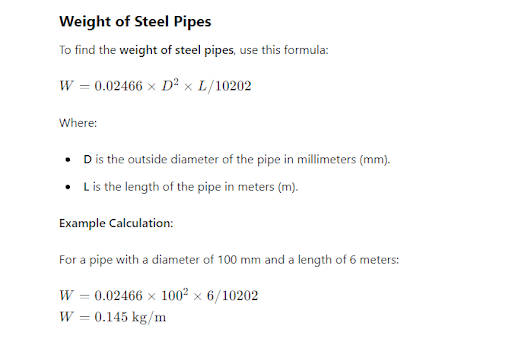
Volume of Inner Cylinder = π * (Inner Radius)² * Length
And the volume of the steel is simply:
Volume of Steel = (Volume of Outer Cylinder) - (Volume of Inner Cylinder)
Or, to make it even simpler, you can factor out the π and Length:

Volume of Steel = π * Length * [(Outer Radius)² - (Inner Radius)²]
See? Not so scary. Now, if you're more accustomed to diameters (the distance all the way across the pipe, through the center, like a perfectly cut pizza), you can easily convert. Radius is just Diameter / 2. So, if you’ve got a 10-inch diameter pipe, it’s got a 5-inch radius. Easy peasy, lemon squeezy… assuming the lemon is made of steel and weighs about 490 pounds per cubic foot.
The Density Factor: Steel's Secret Weapon
Now, let’s talk about density. This is where the "weight" part of "weight calculation" really kicks in. Steel isn't just any metal; it’s a specific blend, mostly iron with a dash of carbon and other fun stuff, giving it its strength and, crucially for us, its weight. The density of steel is typically around 490 pounds per cubic foot. That’s a lot of pounds packed into a tiny space! Or, if you prefer metric, it's about 7850 kilograms per cubic meter. It’s heavy enough that you probably wouldn’t want to drop a pipe on your foot. Unless you have a foot made of something even tougher, like, I don’t know, reinforced concrete.
So, once you've got your volume of steel (in cubic feet or meters), you just multiply it by the density of steel.
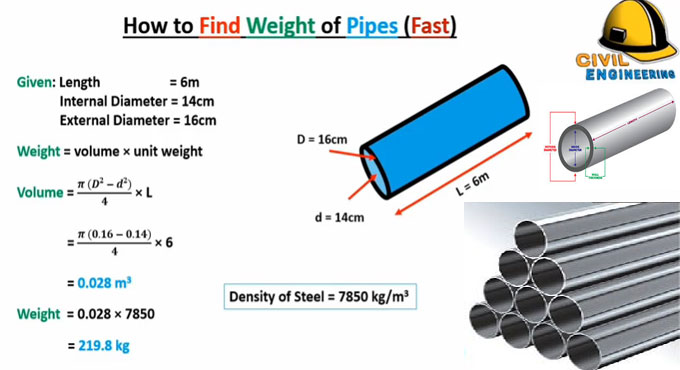
Weight = Volume of Steel * Density of Steel
And there you have it! The weight of your steel pipe, ready to be used for shipping calculations, structural engineering prowess, or impressive party chatter. Imagine the scene: you’re at a sophisticated soirée, sipping on something bubbly, and someone asks about your day. You lean in, a twinkle in your eye, and say, “Oh, just calculating the tensile strength and volumetric mass of several tons of carbon steel piping. You know, the usual.” They’ll be so impressed, they might offer you a job on the spot. Or at least a second helping of the mini quiches.
Common Pipe Plumbing: Making it Easier (or Harder?)
Now, sometimes, you don’t have the inner and outer radii handy. What do you do then? Well, the most common measurement you’ll find for pipes is the Nominal Pipe Size (NPS). This is where things can get a little… quirky. NPS isn't the actual outer diameter, especially for smaller pipes. It's a standardized size designation. So, a 1-inch NPS pipe doesn't actually have a 1-inch outer diameter. It’s like calling a chihuahua a “lion cub” – it gives you an idea, but it’s not precisely accurate.
Then there’s the wall thickness. This is the crucial measurement that determines how much metal is actually in the pipe. For a given NPS, the wall thickness can vary wildly. You can have a thin-walled pipe, perfect for, say, a very fancy, lightweight exhaust system, or a thick-walled pipe that could probably withstand a direct hit from a small asteroid. This variation is often indicated by a Schedule Number (like Schedule 40, Schedule 80). The higher the schedule, the thicker the wall, and, you guessed it, the heavier the pipe. It’s like choosing between a paper-thin napkin and a brick for wiping your mouth – both serve a purpose, but one is significantly more substantial.
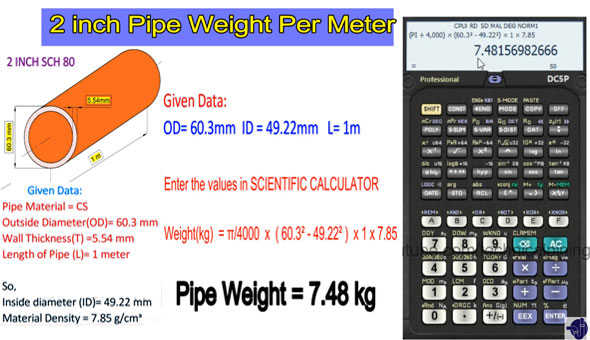
So, if you’re using NPS and Schedule numbers, you’ll need to consult charts or online calculators that have already done the conversion for you. These handy tools essentially have all the specific outer diameters and wall thicknesses pre-programmed, saving you the headache of doing the research yourself. They are the unsung heroes of pipe weight calculation, the silent calculators working diligently behind the scenes, ensuring that your structural integrity remains… well, intact.
The Surprising Facts You Never Knew You Needed
Did you know that the world's longest steel pipe is over 6,000 kilometers long? That’s like stretching a pipe from New York all the way to Los Angeles and then some! Imagine the weight of that! It would require a fleet of elephants, or perhaps a particularly strong herd of rhinos, just to move a section of it.
And here’s a mind-blower: the density of steel can actually vary slightly depending on its exact composition. Some high-strength alloys are denser, while others might be a touch lighter. So, while 490 lbs/ft³ is a great average, a true engineering guru might factor in the specific alloy for ultimate precision. It's like knowing the exact number of sprinkles on a cupcake – not usually necessary, but impressive if you do.
Ultimately, calculating the weight of a steel pipe is a blend of understanding basic geometry, knowing a few key material properties, and perhaps employing a dash of technological assistance. It's not as glamorous as designing a space shuttle, but it’s just as important for making sure things don’t fall down. So, the next time you see a massive steel pipe, you’ll know that behind that imposing exterior lies a carefully calculated weight, a testament to the power of numbers and a little bit of steel.