
What Are Properties Of Transition Metals
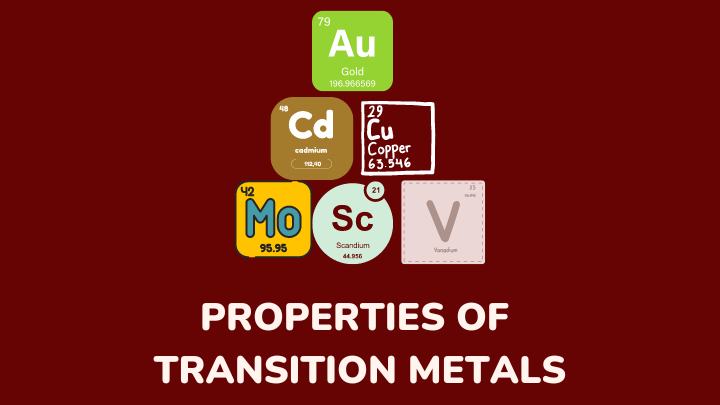
Hey there, curious cats and science stargazers! Ever wonder what makes your sparkly jewelry gleam, your phone buzz with life, or even why some paints boast such vibrant colors? Well, buckle up, buttercups, because we're about to dive into the dazzling world of transition metals! You know, those cool elements lurking in the middle of your periodic table, just waiting to sprinkle a little magic into our everyday lives. They’re not just numbers and symbols, folks; they’re the unsung heroes behind so much of what makes our world fun and functional!
So, what exactly are these elusive critters? Think of them as the adventurous teens of the periodic table. They're a bit more complex than their chill neighbors, and that's precisely what makes them so darn interesting. They’re in that big, chunky block between the highly reactive alkali metals (who are a bit too eager to make friends, bless their hearts) and the more reserved elements on the right. We're talking about elements like iron (you know, for those strong bridges!), copper (hello, electrical wires and pennies!), gold (duh!), silver (sparkly!), and a whole bunch of others that are secretly working wonders all around you.
One of the most defining characteristics, and honestly, one of the coolest, is their ability to form colored compounds. Yep, you heard me! Remember those vivid blues of Egyptian pottery or the stunning greens in stained glass? Often, you can thank transition metals for that. Think of iron creating that earthy red-brown rust (a bit less glamorous, but still a transition metal property!), while cobalt can give you a breathtaking sapphire blue. It's like nature's own paintbox, and transition metals are the star pigments. Isn't that just marvelous? It’s like a little chemical art exhibition happening constantly!
But it’s not all about pretty colors, oh no. Transition metals are also absolute champions when it comes to being catalysts. What’s a catalyst, you ask? Imagine trying to bake a cake, but the oven takes forever to heat up. A catalyst is like a magic button that speeds up the whole process without actually getting used up itself. Mind-blowing, right? Many industrial processes, from making plastics to producing fuels, rely heavily on transition metals like platinum, nickel, and palladium to make things happen faster and more efficiently. So, next time you drive a car or use a plastic item, give a little nod to these amazing catalysts!
Another super neat trick they pull off is forming complex ions. This sounds a bit fancy, but it just means they can link up with other molecules or ions in pretty intricate ways. Think of it like Lego bricks – these metals can connect to different shapes and sizes of 'other pieces' to create entirely new structures. This ability is crucial in biological systems too! For instance, iron is at the heart of hemoglobin, the protein that carries oxygen in our blood. Without iron's complex-forming talent, we wouldn't be able to breathe! And let's not forget chlorophyll, the green pigment in plants that uses magnesium (a close cousin, sometimes grouped with them!) to capture sunlight for photosynthesis. So, transition metals are literally keeping us alive and green!
And the variable oxidation states? This is where things get really interesting for the curious minds. Unlike some elements that stick to one 'charge' or 'personality,' transition metals can flip between several different oxidation states. This means they can play multiple roles in chemical reactions, making them incredibly versatile. Imagine having a tool that can be a screwdriver, a wrench, and a hammer all in one – that’s the power of variable oxidation states! This adaptability is key to their catalytic prowess and their ability to form diverse compounds. It’s like they’ve got multiple personalities for the betterment of chemistry!
Let’s talk about magnetism. Some transition metals, like iron, cobalt, and nickel, are famously ferromagnetic. This is what makes magnets stick to your fridge, what powers those loud speakers, and what allows for all sorts of amazing technologies. This magnetic property stems from the way electrons are arranged in their atoms, a little dance of spinning and orbiting that creates a magnetic field. It’s this invisible force that’s so fundamental to so many everyday objects. Pretty cool to think that the strength of your fridge magnet has its roots in the fascinating properties of a transition metal, right?

You know, it's easy to overlook these elements because they're not as flashy as, say, neon signs. But their contributions are profound. Think about the alloys we use – mixtures of metals that are stronger, lighter, or more resistant to corrosion. Stainless steel, for example, often contains chromium and nickel, both transition metals, making it perfect for everything from kitchen utensils to medical implants. They’re not just elements; they’re the building blocks of progress and convenience!
The more you learn about transition metals, the more you realize how interconnected everything is. That shiny watch on your wrist? Probably contains some gold or platinum. That colorful phone case? Might owe its hue to a transition metal pigment. Even the vibrant green of your lawn is a testament to the power of these elements working in harmony with nature.
So, the next time you see something shiny, colorful, or incredibly strong, take a moment to appreciate the humble transition metal that might be behind it. They’re not just subjects in a textbook; they’re the secret ingredients that make our world a more vibrant, functional, and dare I say, more fun place to be. Isn’t it inspiring to think that such complex and useful properties can arise from the fundamental nature of matter? Keep looking, keep questioning, and you’ll discover even more wonders waiting to be unveiled!