
What Are The Hardest Metals

Hey there! So, you're curious about what makes a metal, well, tough? Like, the kind of tough that makes you scratch your head and say, "Whoa, what is that made of?" You know, the stuff that laughs in the face of a hammer, or could probably hold up a skyscraper single-handedly. We're talking about the heavy hitters, the real MVPs of the metallic world. Ever wonder why some things are super easy to bend, like a paperclip (don't judge, we've all done it), and others? Let's just say they're built different. Like, really different. It's not just about being heavy, oh no. It’s about that inner grit, that resistance to anything you throw at it. Think of it as the metal world's ultimate bouncer. Nobody messes with these guys.
So, what exactly are we talking about when we say "hardest"? It's not just one thing, you know? It's a bit of a mixed bag. Mostly, it’s about how much force it takes to scratch, dent, or deform it. Imagine trying to scratch glass with your fingernail. Easy peasy, right? Now try to scratch a diamond with your fingernail. Yeah, didn't think so. Metals are kinda like that, but with more bling. We're talking about scratch resistance, compressive strength (how much it can be squeezed), and tensile strength (how much it can be pulled before it snaps). It's a whole workout for the metal!
And when we get into the really, really hard stuff? You're probably thinking of, like, futuristic super-suits or maybe something you’d find in a superhero's utility belt. And you wouldn't be entirely wrong! These metals are the unsung heroes of pretty much everything we rely on. From the jet engines that get us across continents to the tiny, intricate parts in your smartphone (yeah, even your phone has some seriously tough metal in it!), they’re everywhere. It's kind of mind-blowing when you stop and think about it. We take so much for granted, don't we?
Let's Dive into the Heavyweights
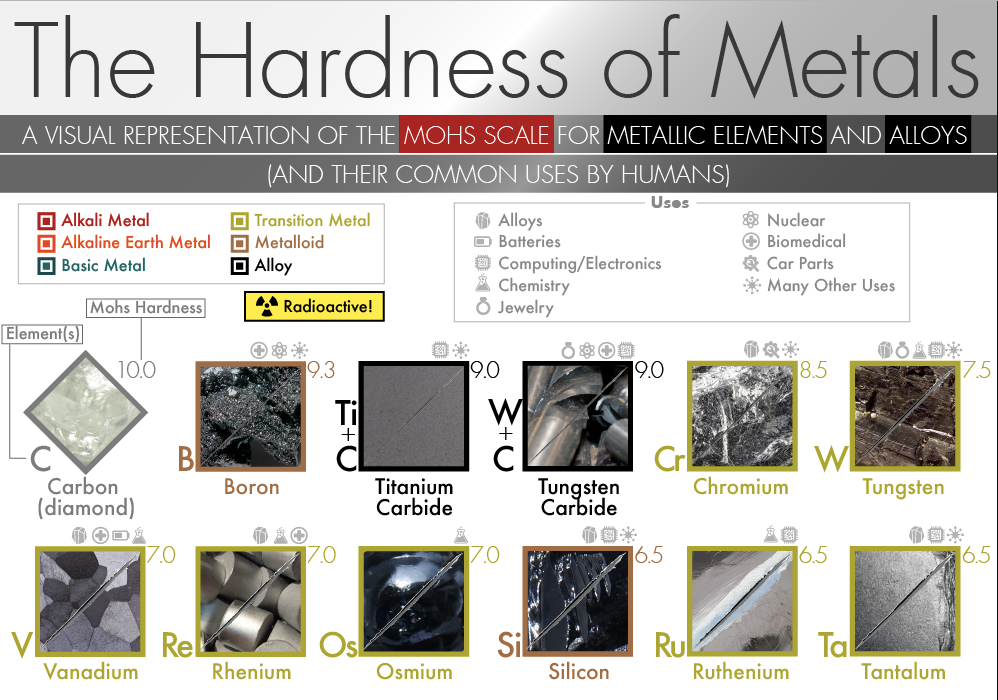
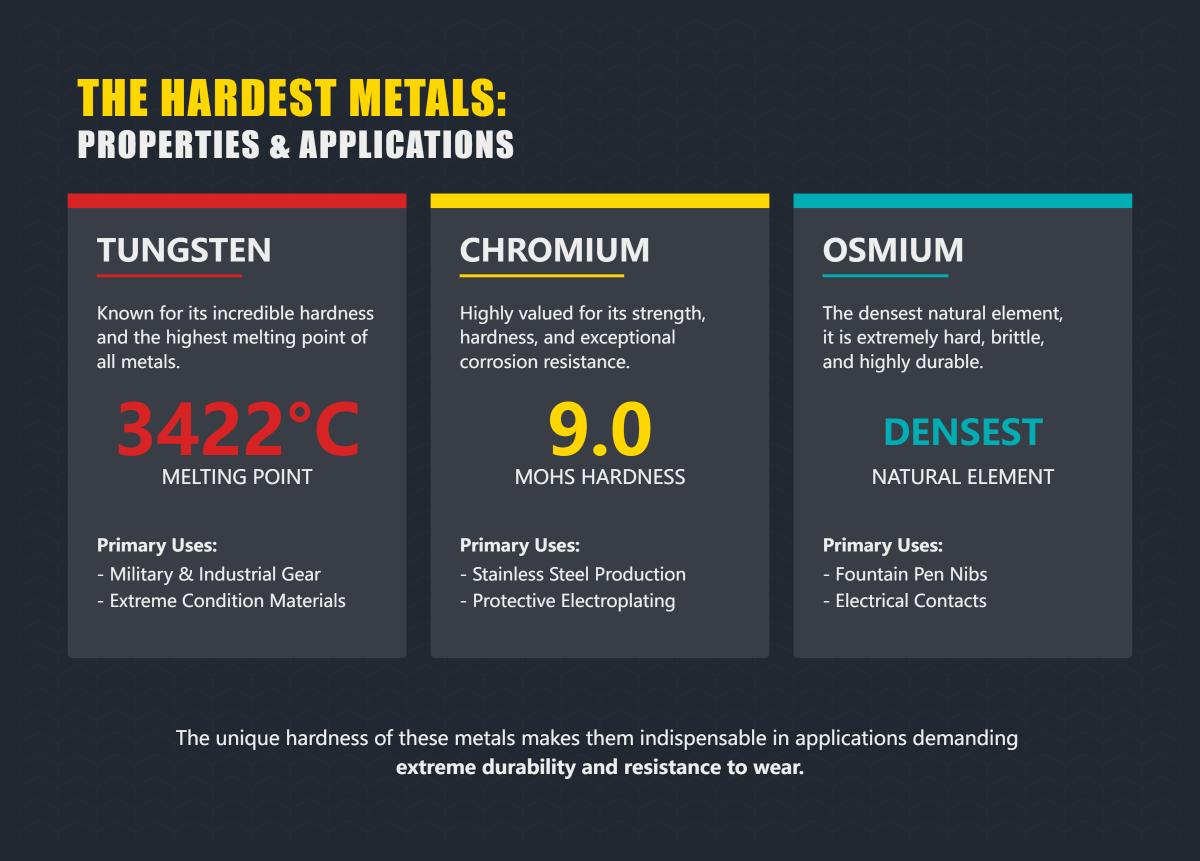
Alright, let's get down to business. Who are these champions of toughness? First up, we have to talk about Tungsten. This guy is an absolute legend. Seriously. If metals had a bodybuilding competition, Tungsten would be the reigning Mr. Universe. It has an unbelievably high melting point, like, it practically needs a supernova to melt. And its hardness? Off the charts. We’re talking about being able to resist wear and tear like nobody's business. It’s used in things that need to withstand extreme heat and abrasion, like drill bits for hard rock mining (imagine drilling into solid granite!), or the tips of those fancy high-speed cutting tools. It’s basically saying, "Oh, you want to cut me? Good luck with that, pal."
Think about it: when you’re digging for diamonds or trying to bore through solid rock, you need tools that are tougher than the rock itself, right? That’s where Tungsten comes in. It’s like the metal version of a superhero whose power is being utterly, ridiculously unyielding. It's probably why it’s also used in things like bulletproof vests, though often in alloys. You don't want to be messing with something that's designed to stop projectiles, do you? I didn’t think so. It’s got that dense, stubborn quality that just screams “I’m not moving, no matter what you do.”
And the name itself, Tungsten? It sounds pretty intense, doesn't it? Like something you'd find in a secret underground lair. It comes from Swedish words meaning "heavy stone." How fitting is that? It’s not just about being hard, it’s about that substantial, unshakeable presence. It’s the kind of metal that makes other metals look a little… soft. Like a velvet pillow next to a brick wall. That’s the difference we’re talking about here.
The Usual Suspects (That Are Anything But Usual)
Now, you might be thinking, "Okay, what about things I actually see more often?" Well, you can't talk about hard metals without mentioning Chromium. This shiny, bluish-white metal is everywhere, even if you don't realize it. Think of your car's chrome bumper, or those super-shiny faucets in your bathroom. That's usually chromium plating. Why? Because it's not only tough, it's also incredibly resistant to corrosion and rust. It's like giving your metal a superhero cape against the elements. No rust bunnies allowed!
Chromium is often used in stainless steel, which is basically steel that's been beefed up with chromium and other goodies. That's why your kitchen sink doesn't get all rusty and gross. It's the silent guardian of your culinary adventures. And it’s not just about looking good; that chromium layer is tough as nails. It’s like a microscopic force field protecting the steel underneath. Imagine your silverware, or even your knife blades. They stay sharp and shiny because of this amazing metal.
But here's a cool little tidbit: chromium itself is actually quite brittle. Kinda surprising, right? When it's pure, it's not as flexible as some other metals. The magic happens when it's alloyed, especially with iron to make steel. It’s like it needs its buddies to bring out its best. It's a team player, but a really, really strong team player. It enhances the properties of other metals, making them tougher and more resilient. It’s the ultimate wingman for metals.
The Unsung Heroes of Strength
Let's keep rolling with the heavyweights. We've got Titanium. This metal has a reputation for being super strong but also incredibly light. It’s like a ninja – silent, deadly, and can lift a car over its head without breaking a sweat. It’s so strong, in fact, that it’s used in aerospace applications. Think airplane parts that need to be both lightweight and able to withstand immense pressure. It’s literally helping us fly through the sky!
And get this, titanium is biocompatible. What does that even mean? It means your body doesn't freak out and reject it. So, it's used in medical implants, like artificial hips and knees. How cool is that? You’re getting a new hip made of metal that’s strong enough to propel you into the future, and your body says, "Yep, this is fine." It’s the ultimate endorsement. It’s the metal that says, “I can handle anything, even your body.”
The reason it’s so strong and light is its atomic structure. It's got this really efficient way of bonding, making it super tough without being weighed down. It’s the perfect balance of brute force and elegance. And while it’s not as hard as Tungsten on the pure scratching scale, its strength-to-weight ratio is pretty much unmatched. It’s the champion of endurance, not just pure power.
The Steel Family Reunion (Where Everyone's Buff)
Now, we have to talk about Steel. But not just any steel, we're talking about Tool Steel. This is the stuff dreams are made of for anyone who works with their hands. It's designed for making tools that cut, shape, and pound other things. So, it has to be incredibly hard and wear-resistant. Think about a chisel that can carve through hardwood without dulling, or a punch that can create precise holes in thick metal. That’s the power of tool steel.
There are tons of different types of tool steels, each with its own special blend of elements like carbon, chromium, vanadium, and molybdenum. These little additions are like secret spices that make the steel extra tough. Vanadium, for example, forms super-hard carbides within the steel, making it incredibly resistant to wear. Molybdenum helps it maintain its hardness even at high temperatures, which is crucial when you’re cutting metal at high speeds and things get… hot.
So, when you see a high-quality knife, a durable hammer, or even the bits on your drill, you're probably looking at some form of tool steel. It's the backbone of so many industries because it just gets the job done, no complaints. It’s the reliable friend who always shows up and does the heavy lifting, literally. It’s the workhorse that keeps everything else running smoothly. And it’s probably been around longer than most of the other metals we've talked about, proving its lasting strength.

The Exotic and the Extreme
Okay, let's venture into some slightly more… exotic territory. Have you ever heard of Osmium? This is a metal that's so dense, it’s almost unbelievable. It's one of the densest naturally occurring elements on Earth. And with that density comes incredible hardness. It’s so hard, in fact, that it’s rarely used in its pure form because it’s incredibly difficult to work with. Think of it as being so tough, it’s almost too tough for its own good.
Osmium is found in very small amounts, often as a byproduct of platinum mining. Because it's so rare and so hard to process, it’s usually reserved for very specialized applications. You might find it in things like fountain pen tips (for that super-smooth, ultra-durable writing experience) or electrical contacts where extreme wear resistance is needed. It's the metal that’s a little bit of a diva – super powerful, but needs careful handling.
The sheer density of osmium is what makes it so hard. It's packed incredibly tightly together at the atomic level. Imagine trying to shove more and more marbles into a box; eventually, it becomes impossible to fit any more, and the whole thing becomes incredibly rigid. That's kind of what's happening with osmium on a microscopic scale. It’s the ultimate testament to how much power can be packed into a small space.
And then there's Rhenium. This metal is also incredibly rare and super hard. It's often used in high-temperature applications, like in jet engine turbine blades. Why? Because it can withstand extreme heat and stress without deforming. Imagine an engine spinning at thousands of RPMs, with temperatures hotter than lava. Rhenium is one of the few metals that can handle that kind of abuse. It’s like the extreme sports athlete of the metal world, constantly pushing the limits.
Rhenium alloys are known for their incredible strength at high temperatures. This is crucial for anything that generates a lot of heat and needs to spin very fast. Without metals like rhenium, modern jet engines wouldn't be possible. It’s the silent, unseen hero that allows us to travel the globe at incredible speeds. It’s the stuff of true engineering marvels, and it all comes down to the inherent toughness of this remarkable metal.
So, Who Wins the Crown?
It's tough to give a single "winner" because, as we've seen, "hardness" can mean different things. If we're talking pure, unadulterated scratch resistance and resistance to deformation under pressure, Tungsten often takes the cake. Its sheer density and high melting point make it incredibly robust. But if you’re thinking about strength-to-weight ratio, then Titanium is a serious contender, allowing for incredible strength without the bulk.
And let's not forget the workhorses. Steel, especially in its tool steel variations, is the king of everyday toughness. It's the metal that built the industrial world and continues to be indispensable. Then you have the exotic players like Osmium, with its mind-boggling density, and Rhenium, with its extreme high-temperature resilience. Each one brings something unique and incredibly strong to the table.
It's a reminder that the world around us is built on materials that can withstand incredible forces. These hard metals aren't just pieces of the periodic table; they are the foundation of our technology, our infrastructure, and even our bodies. So next time you're using a tool, admiring a piece of machinery, or even just looking at your car, take a moment to appreciate the incredible strength of the metals that make it all possible. They’re the quiet giants, the unsung heroes, the true titans of the material world. Pretty neat, right?