
What Did Buckminster Fuller's Knowledge Doubling Curve Theory Reveal
Picture this: you're at a quirky café, sipping a latte that costs more than your first car, and your eccentric aunt Mildred (the one who collects antique doorknobs) leans in conspiratorially. She whispers, "Honey, have you heard about Buckminster Fuller and his knowledge doubling thingy?" You nod, trying to look like you're a regular at these philosophical coffee-fueled deep dives, but inside, you're picturing a gnome frantically multiplying encyclopedias. Well, buckle up, buttercup, because Bucky, as his pals (probably just other incredibly smart people) called him, had some seriously mind-bending ideas about how fast we're all getting smarter. Or at least, how much more we know.
So, what exactly is this "knowledge doubling curve theory"? Forget about your grandma's knitting patterns; this is way more exponential. Bucky, a dude who looked like he belonged in a sci-fi movie with his signature round glasses and a brain that never seemed to take a vacation, noticed something wild. He observed that the total sum of human knowledge wasn't just chugging along like a trusty old steam train. Oh no. It was more like a rocket ship that had just ignited its boosters. He figured out that the amount of new information being generated was doubling at an absolutely insane rate.
The "Whoa, That's Fast!" Revelation
Imagine you're living in, say, the year 1000 AD. You've got a pretty good handle on things. You know how to farm, probably how to swing a sword (or at least a really big stick), and maybe a bit about the local deities. That knowledge base was solid, like a well-built medieval castle. It took centuries, maybe even millennia, to accumulate and double. Think about it: before the printing press, knowledge was a precious, hand-copied commodity, probably guarded by monks who’d frown if you whispered too loudly during their parchment-polishing sessions.
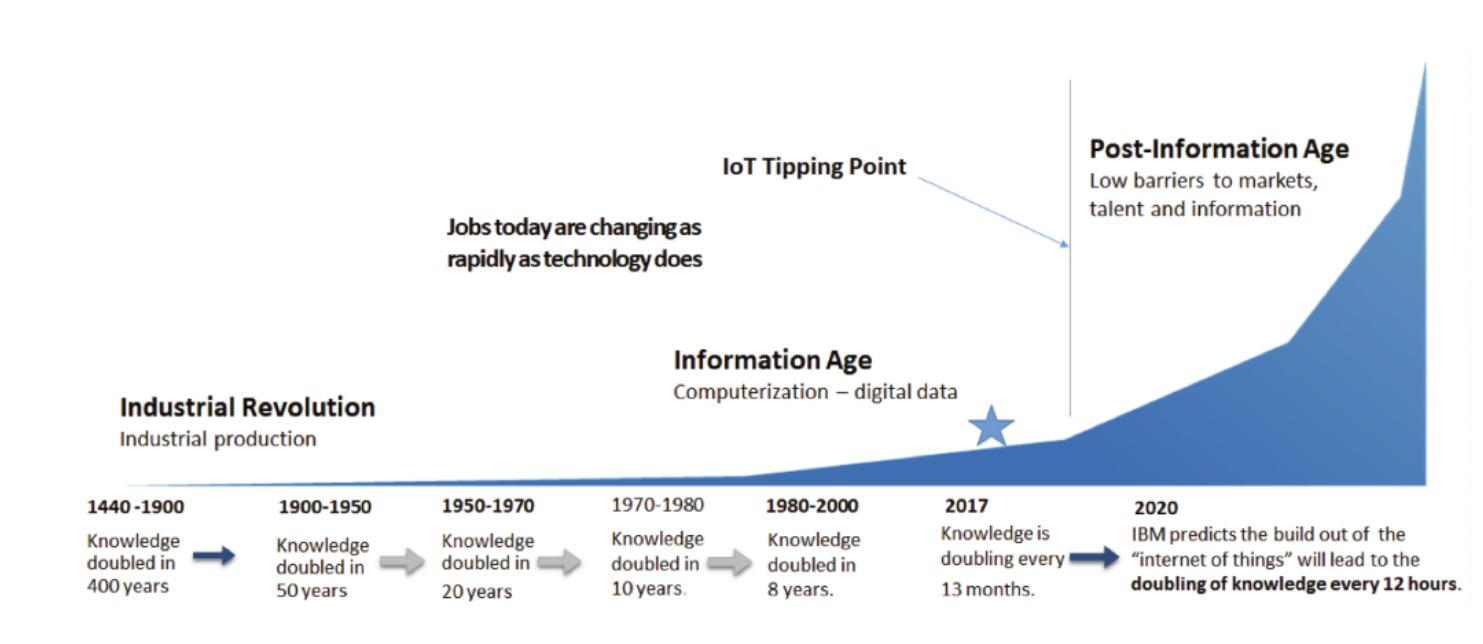
But then, BAM! Gutenberg throws a wrench (or rather, a movable type) into the works. Suddenly, books are a thing. Information starts spreading like wildfire. And Bucky, bless his geodesic-domed heart, realized this was just the warm-up act. He looked at historical data and saw this incredible acceleration. He estimated that back in ancient times, it might have taken thousands of years for human knowledge to double. Then, with the advent of science and more widespread education, it sped up. It got down to centuries, then decades.
And then, the kicker. Bucky, in his infinite wisdom and likely fueled by copious amounts of black coffee, predicted that by the mid-20th century, the doubling time of human knowledge would be a mere 10 years. TEN YEARS! That’s less time than it takes for a teenager to go from awkwardly sprouting pimples to awkwardly wearing a suit to their cousin’s wedding.

The Internet: Bucky's Crystal Ball Strikes Gold
Now, here’s where it gets really spooky. Bucky made his pronouncements long before most of us even knew what a floppy disk was, let alone the glorious, chaotic, cat-video-filled universe of the internet. But his theory? It was basically a roadmap to the digital age. Because if you thought 10 years was fast, the internet took that knowledge doubling curve and basically strapped it to a rocket powered by caffeine and pure human curiosity.
Think about it. Before the internet, if you wanted to know something, you went to a library. You might have to wait for a book, fight over the last encyclopedia volume with a particularly determined librarian, or decipher ancient microfiche. Now? You type a question into Google, and boom! Instant information, or at least, a dozen links that claim to have the answer, some of which will be incredibly useful and others will lead you down a rabbit hole of conspiracy theories about alien lizard people.
Scientists started noticing the doubling time shrinking even further. Some estimates in the digital age put it at 5 years. Then 2 years. And some researchers, looking at specific fields like AI or genetics, would argue that knowledge is doubling every few months, or even weeks. It’s like human knowledge went from a leisurely stroll in the park to a competitive sprint where everyone’s accidentally tripping over each other in their haste to learn more.
So, What Does This Even Mean for Us Regular Mortals?
Well, it’s both exhilarating and a little bit terrifying, right? On the one hand, we have access to more information at our fingertips than all the scholars of the ancient world combined. You can learn to play the ukulele, master the art of sourdough, or understand the intricate political machinations of a fictional space opera, all from your couch. It's like having a personal university in your pocket, albeit one that also constantly tempts you with online shopping deals.

But on the other hand, it’s a constant race to keep up. The skills you learned yesterday might be slightly outdated tomorrow. The hot new technology everyone's talking about could be old news by next Tuesday. It’s enough to make your brain feel like it’s been put through a digital blender. Remember when you finally mastered that complicated video game? Now there are three sequels, a VR expansion pack, and a mobile version that’s probably easier but less satisfying.
Buckminster Fuller’s knowledge doubling curve theory isn't just some abstract academic concept; it’s a fundamental truth about our rapidly evolving world. It explains why you feel like you’re constantly learning new things and why your kids might be explaining concepts to you that sound like they came straight out of a futuristic novel. It’s a testament to human ingenuity, our insatiable curiosity, and our collective ability to generate more information than any single person could ever possibly process. So, the next time you’re drowning in a sea of information, just remember Bucky and his mind-boggling curve. You’re not alone; you’re just living in a time of unprecedented, exponential, and sometimes utterly bewildering, intellectual growth.