
What Do The Colors Mean On Toothpaste Tubes

Have you ever found yourself staring at the toothpaste aisle, feeling like you're deciphering a secret code? That little colored square at the bottom of the tube… it's a mystery that has baffled many a toothpaste user. Are they tiny mood indicators? Hints about secret ingredients? Well, get ready for a revelation that’s both surprising and a little bit silly!
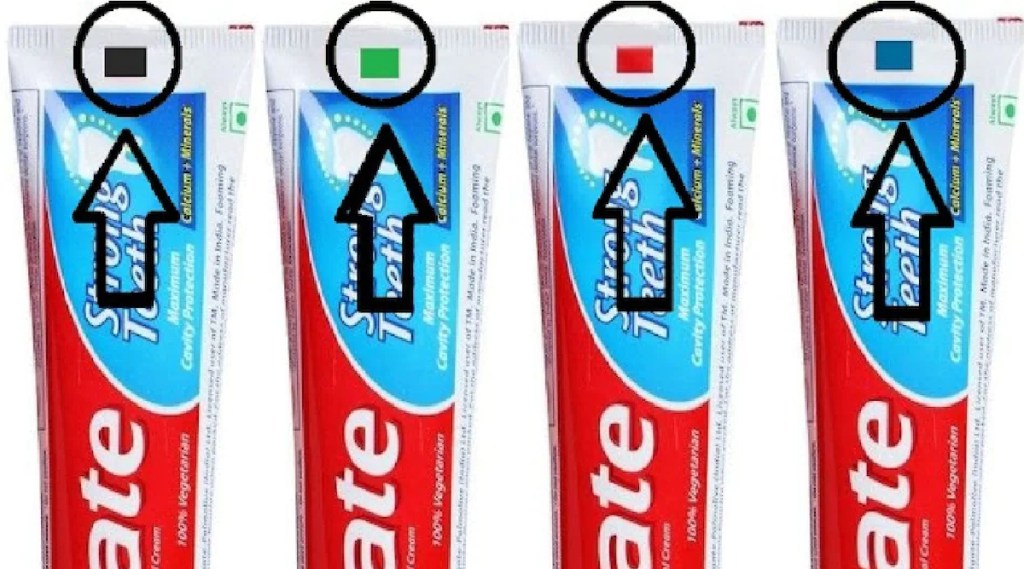
For years, the rumor mill has churned out a popular explanation: the colored squares are a guide to the toothpaste's composition. The story goes that green means natural, blue signifies natural and medicinal, red means natural and chemical, and black means pure chemical. Sounds pretty serious, right? Like you're about to pick your poison for pearly whites.
But here's the twist that might just make you chuckle: that popular theory is, for the most part, a total myth! It's a story that's been passed around so much, it’s become a toothpaste legend, whispered in dentists' offices and debated at the breakfast table.
So, if it's not a secret ingredient decoder, what is that little colored dot? The real answer is far less dramatic, but perhaps even more interesting in its simplicity. Think of it like this: it's all about how the toothpaste is made, but not in the way you might think.
These colored squares are actually called "indicator marks" or "registration marks." Their primary purpose is for the machines that manufacture and package your toothpaste. These high-tech contraptions use the colored marks to know where to cut and seal the tubes with incredible precision.
Imagine a giant, speedy production line. As the tubes whiz by, a sensor spots the colored mark. It's like a tiny flag that tells the machine, "Okay, cut here!" or "Seal the cap right now!" This ensures that every single tube is perfectly sealed and neatly trimmed, giving you that satisfying, factory-fresh feel.
The colors themselves are chosen by the packaging printers. They might pick a color that contrasts well with the artwork on the tube, making it easier for the machines to detect. Sometimes, it’s just whatever color ink is readily available and works best for their specific printing process. No magic, no hidden meanings, just pure, efficient manufacturing.

Think of it like the tiny dot on your phone screen that helps the assembly line put it together perfectly. It’s a detail so small, yet so crucial for the final product. Your toothpaste tube isn't trying to be sneaky; it's just being efficiently produced!
The myth is so persistent, though, isn't it? It speaks to our desire for order and meaning in everyday objects. We want to believe there's a hidden layer of information, a secret language we can unlock. And who wouldn't want to feel like they're making a health-conscious choice based on a subtle clue?
It's a heartwarming thought that these little marks are part of a much larger, very human endeavor: creating products that we use every day. It’s the unsung heroes of the factory floor, the precision of engineering that brings you that minty fresh breath.
So, the next time you're brushing your teeth, take a peek at that little colored square. Instead of a cryptic message about chemicals, imagine the whirring machines, the precise cuts, and the journey your toothpaste took to get to your bathroom. It's a tiny piece of industrial magic, designed to make sure your toothpaste is exactly as it should be.
You might even feel a little bit more connected to the process. It’s like knowing a fun fact about your favorite snack or a little-known detail about a movie. It adds a layer of appreciation to something we often take for granted.
The most common colors you'll see are black, blue, green, and red. While the myth assigned specific meanings to each, the reality is that these colors were likely chosen for their visibility to the optical sensors on the packaging machines.
A dark color like black or dark blue might offer a strong contrast against the lighter background of the tube, making it easy for the sensors to pick up. A bright color like green or red could also stand out effectively.
The story of the colored squares is a perfect example of how information can spread and evolve, sometimes taking on a life of its own. It’s a modern-day folktale, a piece of urban lore that has become ingrained in our collective consciousness.
It’s a reminder that sometimes, the simplest explanation is the most likely one, even if it’s not as exciting as a secret ingredient code. The beauty of it is that the real story is still quite fascinating, highlighting human ingenuity and the complex systems that bring us our daily essentials.

So, go ahead, pick the toothpaste with the funny-colored dot. It’s not a warning, it’s not a badge of honor. It’s simply a sign of a well-made product, ready to deliver its promised freshness. And that, in its own way, is pretty wonderful.
You can even try to spot the differences between brands. Does one brand consistently use red, while another favors blue? This might tell you something about their specific packaging machinery or printing preferences, adding another small, quirky detail to your toothpaste exploration.
Perhaps the true "meaning" of the colored square is to inspire a moment of curiosity, a tiny pause in our busy lives to wonder about the things around us. It’s an invitation to look a little closer, to ask questions, and to appreciate the craftsmanship that goes into even the most mundane items.
The next time you’re in the toothpaste aisle, armed with this knowledge, you can feel a little bit like a toothpaste insider. You’re in on the secret, the real, non-mythical secret, that is. And that’s a rather delightful thought, isn’t it?

It's amazing how something so small can spark so much discussion and lead to such a widespread misconception. The toothpaste tube mystery is a testament to the power of a good story and our human tendency to find patterns and meanings everywhere.
So, rest assured, your toothpaste is not trying to communicate with you through color codes. It’s simply a product of careful design and efficient manufacturing, all aimed at getting that minty goodness into your mouth. And for that, we can all be thankful. Happy brushing!
Remember, the real story behind the colored squares is about precision engineering, not chemical confessions. It’s a wink from the manufacturing world, ensuring your tube is sealed just right.
Think of it as a tiny, colorful signature from the machines that brought your toothpaste to life. It's a subtle nod to the complex ballet of automated production that happens behind the scenes. It's a reminder that even the most ordinary objects have a journey.
So, embrace the lack of a secret code! The truth is often less dramatic, but it’s still a fascinating glimpse into how things are made. It’s the hidden magic of the everyday, waiting to be discovered.