
What Does The Orifice Tube Do

So, picture this. I’m wrestling with a stubborn garden hose, the kind that’s decided it’s going to spontaneously unravel itself into a Gordian knot of green rubber. The water pressure’s all over the place, a pathetic dribble one minute, a surprisingly aggressive jet the next. It’s like the hose itself has a split personality. My neighbor, old Mr. Henderson, leans over the fence, a twinkle in his eye, and says, “You know, sometimes, it’s the simplest things that cause the biggest headaches.” He then proceeds to adjust a tiny, almost invisible little gizmo on the faucet. Bam. Perfect water flow. Made me feel like a complete buffoon, honestly.
And that, my friends, is a surprisingly accurate metaphor for a lot of mechanical bits and bobs. Like, say, an orifice tube. You probably haven’t given it much thought. Why would you? It’s not exactly the shiny, exciting part of your car that screams “look at me!” It’s more of a… well, a hole with a purpose. But, like Mr. Henderson’s faucet doodad, this seemingly insignificant component can be a real game-changer. Or, if it’s gone wonky, a real pain in the… well, you get the idea.
Today, we’re diving headfirst (or maybe just a polite toe-dip) into the mysterious world of the orifice tube. What does this little guy actually do? And why should you care if it’s doing its job properly? Let’s unravel this thing, shall we?
The Grand Entrance: What Exactly IS an Orifice Tube?
Alright, let’s get down to brass tacks. An orifice tube is, at its core, a precisely sized restriction. Think of it as a tiny, carefully engineered bottleneck. It’s usually found in systems where you need to control the flow and pressure of a fluid, be it liquid or gas. In the automotive world, its most common haunt is the air conditioning system.
Now, I know what you’re thinking. “Air conditioning? I thought that was all about compressors and refrigerants and freezing my eyeballs off.” And you’re not wrong! But the orifice tube plays a crucial, albeit silent, role in that whole chilly operation. It’s like the bouncer at a very exclusive, very cold club. It decides who gets in, and more importantly, how they get in.
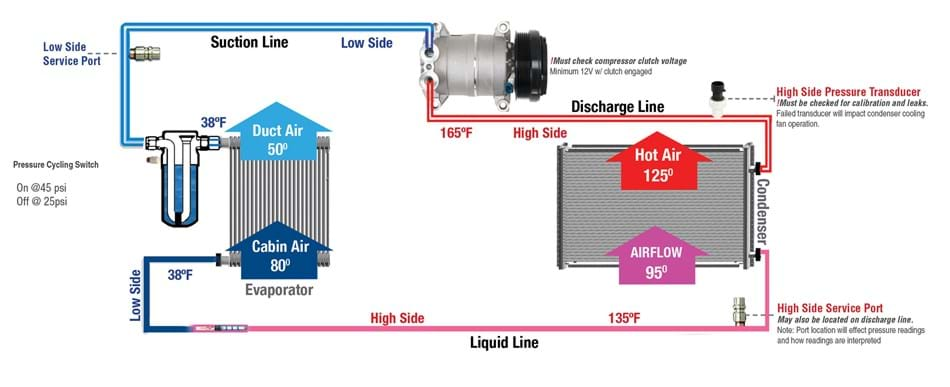
Imagine the refrigerant in your AC system. It starts as a high-pressure liquid. To actually cool anything, it needs to expand and turn into a low-pressure gas. This phase change is where the magic happens. And the orifice tube? It’s the gatekeeper for that transformation.
The Orifice Tube's Day Job: Controlling the Flow
So, how does this tiny tube achieve such a crucial task? It’s all about physics, baby! The refrigerant, under high pressure, is forced to squeeze through this small, precisely machined opening. This restriction causes a sudden and dramatic drop in pressure.
Think of it like this: you’re trying to push a whole herd of cattle through a single, narrow gate. They’re going to get a bit… discombobulated, right? They’ll bunch up, then spread out wildly as they get through. The refrigerant does something similar. As it’s forced through the orifice, it’s like it’s being given a forceful nudge from high-pressure liquid to low-pressure gas. This rapid expansion is what allows it to absorb heat from the cabin of your car, thereby cooling you down.
It’s a pretty elegant solution, if you ask me. No complicated valves, no whiz-bang gizmos. Just a simple, well-placed hole. Simplicity is often the ultimate sophistication, as someone smart probably said once.
Beyond the AC: Other Places You Might Find Them
While the AC system is where most of us will encounter an orifice tube, they aren’t exclusively for keeping our cool. You might find similar restriction devices in other fluid systems. For example, in some fuel injection systems, a kind of orifice might be used to atomize fuel, turning it into a fine spray for better combustion. Think of it as making sure the fuel gets broken down into tiny, manageable droplets that burn more efficiently.
In industrial settings, you’ll find them in all sorts of places where precise fluid control is needed. From manufacturing processes to hydraulic systems, wherever you need to regulate pressure and flow, a good old orifice tube might be lurking, doing its quiet, important work. It’s a testament to how a fundamental concept can be applied in so many different ways. Pretty cool, right?
The Orifice Tube vs. The Expansion Valve: A Friendly Rivalry
Now, if you’re a bit of an automotive DIYer or have spent some time poking around under the hood, you might have heard of something called an expansion valve. And you might be thinking, “Wait a minute, isn’t that doing the same thing as an orifice tube?”
And you’re partially right! Both the orifice tube and the expansion valve are responsible for that crucial pressure drop that makes your AC cold. However, they operate on slightly different principles and are found in different AC system designs. Think of them as two different tools for the same job, each with its own advantages and disadvantages.
The orifice tube is generally found in what’s called a fixed-orifice system. It’s a more basic design, and as the name suggests, the restriction is fixed. It’s always the same size. The expansion valve, on the other hand, is found in a variable-orifice system. This little beauty is more sophisticated. It can actually adjust the size of the opening based on the system’s needs. It’s like having a faucet that can automatically dial back the flow if it’s getting too strong, or open up if it’s too weak.
So, why would you choose one over the other? Well, orifice tube systems are often simpler, less expensive to manufacture, and generally more robust. They’re great for a wide range of operating conditions. Expansion valves, with their ability to adapt, can offer slightly better efficiency, especially in fluctuating temperatures. They can prevent over-cooling and make the system work a bit smarter.

But here’s the kicker: when an orifice tube goes bad, it’s usually pretty obvious. When an expansion valve starts acting up, it can be a bit more nuanced. It’s like the difference between a light switch that’s completely broken and one that flickers intermittently. Both are annoying, but one is harder to pinpoint.
When the Orifice Tube Decides to Take a Break (Or Just Break)
So, what happens when this little bottleneck decides it’s had enough of a good thing? Well, it can manifest in a few ways, and usually, it all comes down to poor AC performance.
One of the most common issues is a clogged orifice tube. Over time, tiny bits of debris, moisture, or even particles from a failing compressor can make their way into the system. If these bits get stuck in the tiny opening of the orifice tube, they can restrict or completely block the flow of refrigerant. Imagine trying to drink a thick milkshake through a coffee stirrer. Yeah, it’s not going to be a good time.
When your orifice tube is clogged, you’ll likely notice that your AC isn’t blowing as cold as it used to. It might be blowing lukewarm air, or worse, just regular outside air. The system might be working, but it’s not doing its primary job effectively because the refrigerant can’t get through to do its cooling magic.
Another scenario, though less common for the tube itself to fail in the sense of breaking, is if the screen filter that’s often attached to it gets clogged. This screen acts as a pre-filter, catching larger debris before it can even reach the orifice. If that gets plugged, you’ll have similar symptoms of restricted flow.
And then, of course, there’s the possibility of it being the wrong size. This is less likely to happen spontaneously, but if someone has replaced it with an incorrect part, or if there was an issue during manufacturing, it could lead to performance problems. You wouldn’t put a garden hose nozzle meant for a sprinkler on a fire hose, right? It just wouldn’t work properly.

Diagnosing the Tiny Troublemaker
So, how do you figure out if your orifice tube is the culprit behind your AC woes? This is where things can get a bit technical, and honestly, if you’re not comfortable with AC systems, it’s probably best to leave this to a professional. But, for the curious minds out there, here are some clues:
High-Side Pressure Issues: When the orifice tube is restricted, the high-pressure side of your AC system will tend to build up excessive pressure. This is because the refrigerant can’t flow freely into the low-pressure side.
Low-Side Pressure Issues: Conversely, the low-pressure side might show abnormally low pressure, or even a vacuum, as refrigerant struggles to get to it.
Temperature Differences: A significant temperature difference between the inlet and outlet of the orifice tube, when it should be the other way around, can also be a red flag.
Visible Debris: If the system is opened up (and again, this is a job for the pros, as refrigerants are under pressure and can be dangerous), a mechanic might be able to visually inspect the orifice tube and its screen for blockages.
Refrigerant Charge: Sometimes, an improperly charged system can mimic orifice tube issues, so it’s important to rule out other common problems first.

It’s a bit like being a detective. You gather clues, you look for patterns, and you try to narrow down the possibilities until you find the one responsible. And in the AC world, the orifice tube is often a prime suspect when things aren’t as chilly as they should be.
Replacement: The Little Tube That Could (Be Replaced)
If it’s determined that your orifice tube is indeed the bad actor, the good news is that it’s generally a replaceable part. The bad news is, it’s not always the easiest or cheapest fix.
Here’s why: replacing an orifice tube usually involves discharging and recharging the AC system with refrigerant. This requires specialized equipment and knowledge to do it safely and correctly. Venting refrigerant into the atmosphere is a big no-no, environmentally speaking, and dealing with pressurized refrigerant can be dangerous if you don’t know what you’re doing. So, unless you’ve got a vacuum pump, a set of manifold gauges, and a good understanding of AC service, this is a job best left to the professionals.
The process typically involves recovering the old refrigerant, removing the AC line where the orifice tube is located, extracting the old tube, installing the new one, and then recharging the system with the correct amount of refrigerant and oil. It’s a multi-step process that, while not outrageously complex in theory, requires precision and the right tools.
And, here’s a little ironic twist for you: sometimes, when a compressor fails, it sends debris throughout the AC system. In these cases, it’s often recommended to replace the orifice tube (and sometimes the receiver-drier) as a preventative measure, even if they don't appear to be clogged yet. Why? Because that little screen on the orifice tube can only do so much, and you don’t want those tiny particles to cause another expensive failure down the line.
The Takeaway: Don't Underestimate the Small Stuff
So, there you have it. The humble orifice tube. It’s not glamorous, it’s not something you’ll brag about to your friends, but it’s an absolutely vital component in your car’s comfort. It’s a perfect example of how a simple, well-designed piece of engineering can have a profound impact on your daily life, especially when that daily life involves a sweltering summer commute.
Next time you’re enjoying that blast of cold air, take a moment to appreciate the silent work of the orifice tube. It’s doing its job, ensuring that the refrigerant can do its job, and keeping you cool as a cucumber. And if your AC starts acting up, remember Mr. Henderson and his faucet – sometimes, the simplest, smallest parts are the ones that deserve a closer look. Don't underestimate the power of a precisely engineered hole!