
What Ended The Era Of Good Feelings

Ever wondered if there was a time in history when everyone just… got along? Well, buckle up, because the Era of Good Feelings in American history sounds remarkably like that! But like all good things, it eventually came to an end. And understanding why that happened is actually pretty fascinating, and can offer some surprising insights into our own times.
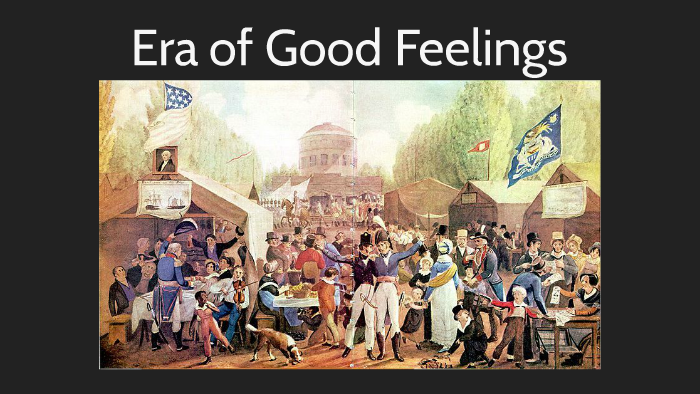
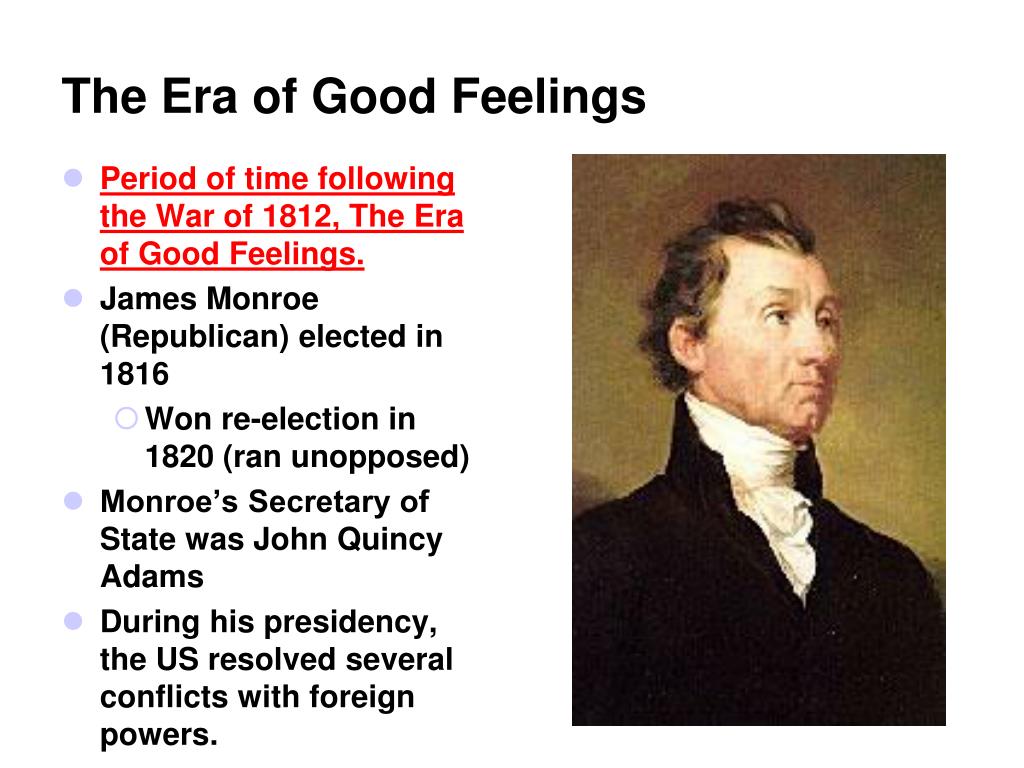
So, what exactly was this "Era of Good Feelings"? It was a period in U.S. history, roughly from 1815 to 1825, following the War of 1812. The name itself suggests a time of national unity and political harmony. With the divisive issues of the war behind them and a strong sense of national pride blooming, Americans felt a sense of optimism and shared purpose. The dominant political party at the time, the Democratic-Republicans, seemed to be in control, and there was a general feeling that the country was on a stable, prosperous path. It was a chance for the young nation to breathe and consolidate its identity.
The benefits of this period were tangible. It fostered a climate conducive to economic growth and westward expansion. Nationalistic sentiments surged, leading to increased investment in infrastructure like roads and canals. It was a time when the country was building itself up, both physically and ideologically. Think of it as a period of collective deep breaths and forward-thinking after a significant challenge.
While we might not have a direct "Era of Good Feelings" in our daily lives, the principles behind it are still relevant. In education, understanding this period helps students grasp how national moods can shift and how even periods of apparent calm can be brewing with underlying tensions. In daily life, recognizing the desire for unity and understanding, even when disagreements exist, is a valuable lesson. It encourages us to look for common ground and appreciate moments of collective progress.
But, as the saying goes, all good things must come to an end. So, what exactly burst this bubble of harmony? Several factors contributed to the demise of the Era of Good Feelings. Firstly, while it was called an "era of good feelings," it was also an era of growing sectionalism. The economic interests of the North, South, and West began to diverge more significantly. The North was industrializing, the South was increasingly reliant on slave labor and agriculture, and the West was focused on land and expansion. These differing priorities inevitably led to political friction.
Then there was the Missouri Compromise of 1820. This was a crucial turning point. The debate over whether Missouri should be admitted as a free or slave state exposed the deep and dangerous divide over slavery. While the compromise temporarily resolved the issue, it highlighted the simmering conflict that would eventually lead to the Civil War. It was a stark reminder that the "good feelings" didn't extend to everyone, particularly enslaved people.
Finally, the economic panic of 1819 also played a role. A boom and bust cycle shook the economy, leading to widespread financial hardship and social unrest. This economic instability eroded the optimistic outlook and introduced new anxieties and grievances. People started looking for someone to blame, and the sense of shared purpose began to fray.
Want to explore this more? It's surprisingly simple! You can start by looking up summaries of the Missouri Compromise or the Panic of 1819. Think about how economic downturns or major political debates in our own time might create similar divides. Sometimes, the most interesting history is found in understanding how seemingly peaceful periods can hold the seeds of future conflict, and how the end of one era can pave the way for the beginning of another.