
What Gauge Is Best For Stainless Steel Sink

Alright, settle in, grab your latte, and let's talk about something that might sound as exciting as watching paint dry, but I promise you, it's got more drama than a reality TV show: stainless steel sink gauges. Yeah, I know, thrilling. But stick with me, because choosing the wrong gauge for your sink is like buying a pair of skinny jeans for a Thanksgiving dinner – it’s going to end in tears and regret.
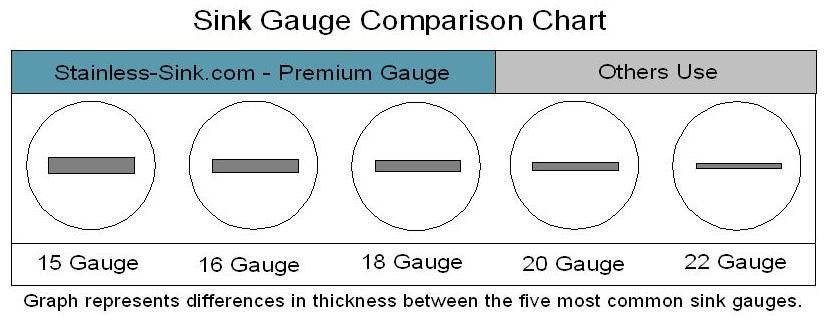
So, what exactly IS this mysterious "gauge" we're talking about? Think of it as the thickness of your sink’s metal. The lower the number, the thicker the steel. It’s like the opposite of a diet plan, where a lower number is always better. This isn’t some abstract concept; this is the difference between a sink that hums along, serenely catching your rogue pasta strands, and one that vibrates like a cheap smartphone during a Beyoncé concert every time you run the water.
The Gauge Game: High Stakes for Your Kitchen
Now, the most common players in the stainless steel sink gauge arena are usually 16-gauge and 18-gauge. You might see 20-gauge lurking in the shadows, usually found in those bargain-bin monstrosities that feel like they're made of foil. We’ll get to those later, don’t you worry.
Let’s start with our good ol’ friend, the 18-gauge. This is your workhorse, your everyday hero. It’s like the reliable sedan of the sink world. It’s perfectly adequate for most kitchens. You drop a fork in it? It’ll probably survive. You accidentally let your toddler practice their drum solo on it with a spatula? It might make it. It's usually the more affordable option, which is always a nice little bonus when you’re trying to convince yourself that granite countertops were a necessary investment.
But here's the catch, folks. While 18-gauge is fine, it can sometimes feel a bit… flimsy. Imagine washing a cast iron skillet the size of a manhole cover in an 18-gauge sink. You might feel the entire kitchen doing a little shimmy. It’s also more prone to those annoying little dings and scratches. Think of it as a canvas for your culinary adventures – every dropped spoon becomes a permanent artistic statement.

Enter the Champion: The Mighty 16-Gauge
Now, let’s talk about the heavyweight champion, the undisputed king of the kitchen basin: the 16-gauge. This is the sink that laughs in the face of dropped pots and pans. It’s the tank, the fortress, the… well, you get the idea. It’s significantly thicker than 18-gauge. We’re talking about a difference you can actually feel.
Why is this so important, you ask? Because a thicker sink is a quieter sink. That annoying clang-clang-clang every time water hits it? The 16-gauge minimises that to a satisfying thump. It’s like upgrading from a tin can drum kit to a professional symphony orchestra. Your ears will thank you. Your neighbours will thank you. Your spouse, who has been subtly hinting about "kitchen acoustics," will definitely thank you.
Furthermore, that extra thickness means superior durability. Dings? Scratches? These become much less of an issue. A 16-gauge sink can handle the enthusiastic (and let's be honest, sometimes violent) actions of even the most spirited home chef. Think of it as an investment in your sanity and the longevity of your kitchen's aesthetic appeal. It's the difference between a sink that looks like it’s been through a minor war zone after a few years and one that still gleams with pride.
The Dreaded 20-Gauge (and Why to Avoid It Like a Bad Tinder Date)
Okay, let’s address the elephant in the room, or rather, the flimsy tin can in the kitchen showroom: the 20-gauge. Honestly, I wouldn't recommend a 20-gauge sink for anything more demanding than washing a single, delicate teacup. It’s the equivalent of a wet paper bag in a hailstorm. It’s going to dent. It’s going to scratch. It's going to flex and vibrate like it’s doing the cha-cha with every water droplet.
If you see a sink advertised as 20-gauge and the price seems too good to be true, it probably is. It’s the kind of sink that will have you pining for your old, trusty utility basin within months. Avoid it. Seriously. Unless your primary culinary activity involves gently misting herbs with Evian, steer clear.
So, What Gauge IS Best? The Verdict is In!
For the vast majority of us, the sweet spot for stainless steel sinks is a 16-gauge. It offers the perfect blend of durability, quiet operation, and a premium feel without breaking the bank like some artisanal truffle pig. It’s the Goldilocks of sink gauges – not too thin, not too thick, but just right.
If your budget is extremely tight, and you’re willing to live with a few more battle scars on your sink, an 18-gauge can be a decent compromise. But if you can stretch your budget even a little bit, go for the 16-gauge. Your future self, the one who isn't cringing every time the dishwasher rattles, will thank you profusely. It’s a small detail that makes a huge difference in the daily symphony of your kitchen.
Think about it: you spend a lot of time in your kitchen, right? You’re chopping, you’re washing, you’re probably doing the dishes while contemplating the meaning of life or planning your next vacation. Doesn’t that space deserve a sink that’s as resilient and pleasant as possible? A 16-gauge sink is an investment in a quieter, more enjoyable kitchen experience. It’s the unsung hero of your countertop, silently, and beautifully, doing its job. So next time you’re shopping for that gleaming new sink, remember the gauge. It’s not just a number; it’s the difference between a kitchen that sings and a kitchen that… well, complains a lot.