
What Is The Color Of The Star Vega
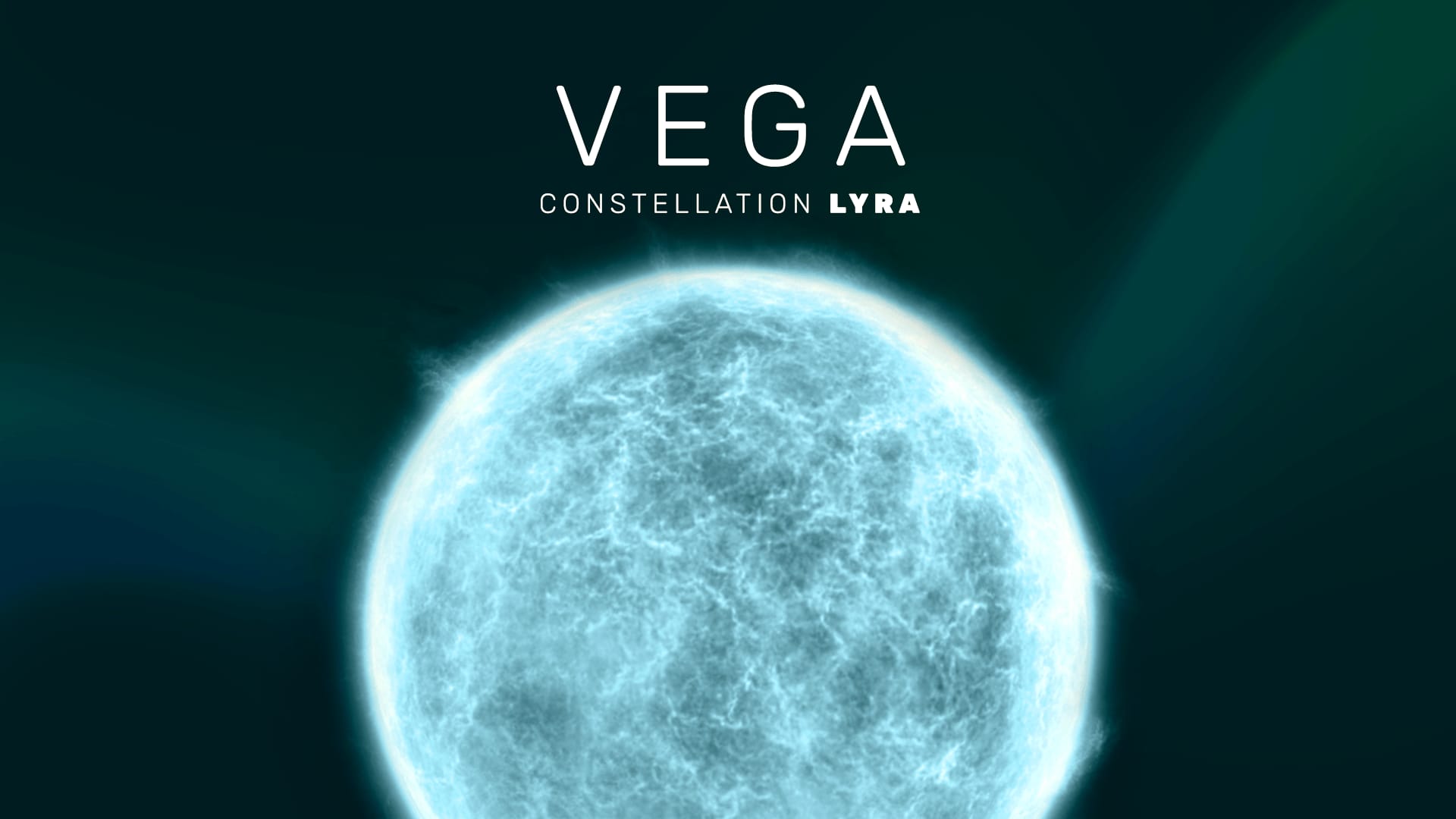
Alright, gather ‘round, you stargazing wannabes and cosmic curious cats! We’re about to dive into a question that’s been keeping astronomers up at night (well, maybe not that late, they have jobs, you know). We’re talking about Vega. Yeah, that Vega. The bright, shiny one that practically screams, “Look at me!” in the night sky. You’ve probably pointed it out to someone at some point, possibly while trying to impress them with your vast celestial knowledge, which, let’s be honest, might have consisted of, “That one’s… really bright.”
So, what color is this celestial show-off? Now, before you whip out your handy-dandy crayon box and pick “sparkly blue” or “supernova pink,” let me tell you, it’s a little more nuanced. It’s like asking the color of a really good cup of coffee. Is it brown? Sure. But it’s also the color of a productive Tuesday morning, the color of that satisfying sigh after a long week, and the color of, well, caffeine-induced brilliance. See? Complicated!
For a long time, and I mean looooong time, like, pre-internet, pre-pizza, probably pre-fire kind of long, people just assumed Vega was… well, white. Or maybe a slightly jazzed-up white. It’s the default setting for a lot of stars, right? They’re just these bright pinpricks. But our eyes, bless their simple little hearts, aren't exactly calibrated for pinpoint astronomical color accuracy. Think about trying to judge the exact shade of a red car at midnight with only a flickering candle. Not ideal.
Here’s where it gets actually interesting. Vega is what we call a “blue-white” star. Now, don’t get too excited and imagine it’s wearing a tiny denim jacket. It’s not that literal. It means that its light is dominated by bluer wavelengths, but it still has enough of the other colors mixed in to appear white to our imperfect human peepers. It’s like a perfectly balanced smoothie. Too much blue, and it’s… well, blue. Too much red, and you’ve got a flavor disaster. Vega’s got that cosmic culinary skill down pat.
Why Does It Look White (Mostly)?
So, if it’s got this bluey-bacon-y essence, why does it look so… white? It’s all about temperature, folks. Stars are basically giant, fiery furnaces. And like any good furnace, they’ve got different temperature settings, which, surprise, surprise, dictate their color. Hotter stars? They lean towards blue. Cooler stars? They’re more reddish. Vega is right there in the sweet spot, relatively speaking, being a scorching hot customer.
Imagine a blacksmith’s forge. When the metal is just starting to heat up, it glows a dull red. As it gets hotter, it turns orange, then yellow, and if you could push it really far, you’d eventually get to that blindingly white-hot stage. Vega is way up there on that scale. It’s so hot, in fact, that it’s like the universe’s personal hairdryer, constantly blasting out intense energy.
But here’s the cosmic kicker: Vega is so hot that its blues are actually a little too intense for us to perceive as pure blue. Our eyes, again, being the trusty but sometimes dim bulbs they are, get a bit overwhelmed. It’s like trying to listen to your favorite song on ridiculously loud speakers. You hear the music, but the sheer volume might be making it hard to appreciate all the subtle nuances. Vega’s blues are so loud, they sort of blend into a bright, dazzling white for us.
A Surprising Twist: Vega is Melting (Sort Of)
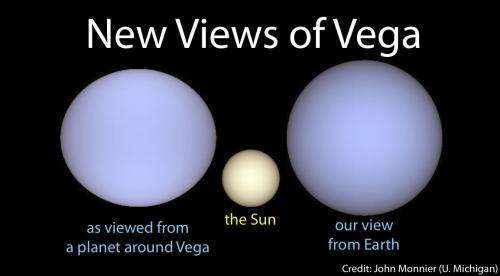
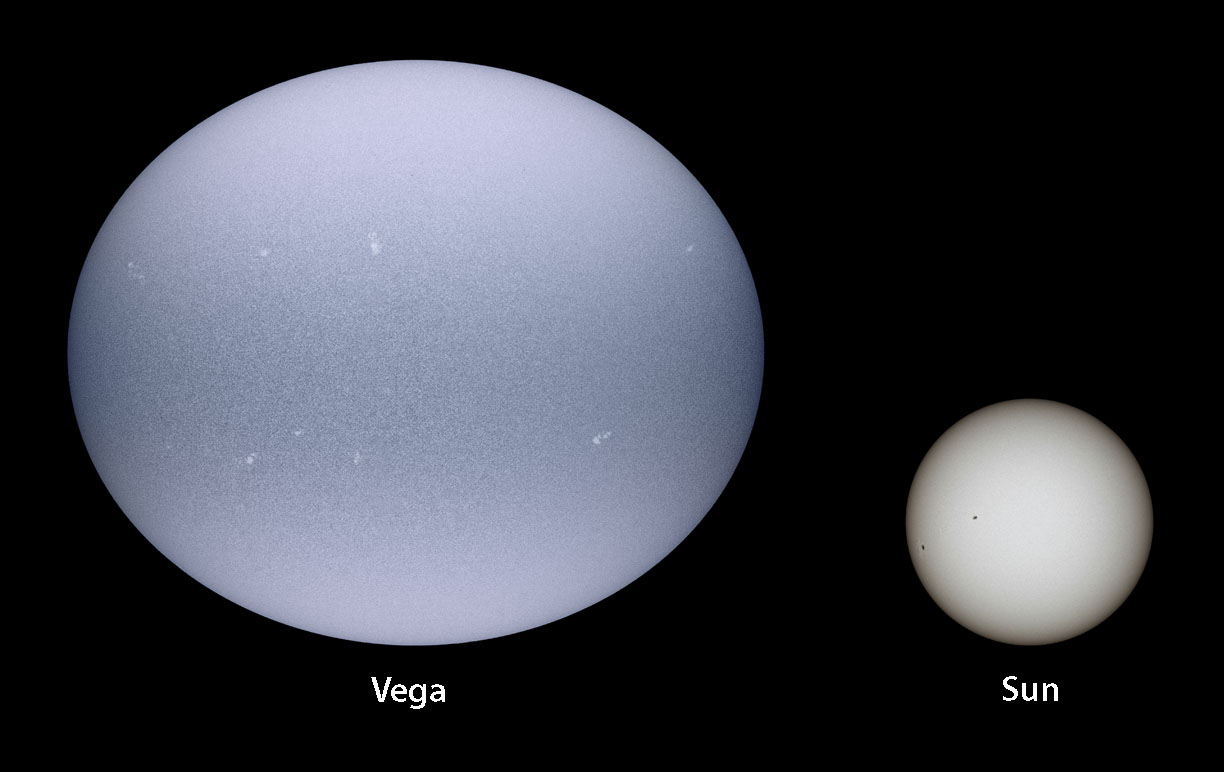
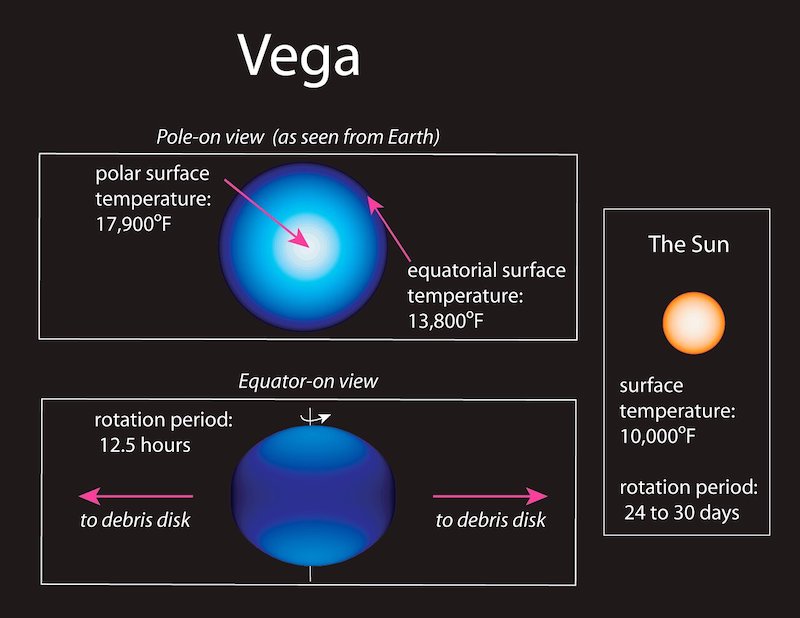
Now, for a bit of a plot twist that would make M. Night Shyamalan proud. You see, Vega is so incredibly hot and spinning so incredibly fast that it’s actually flattening out. Yes, you heard me right. It's not perfectly spherical like a well-rounded celebrity. It's more like a cosmic frisbee that’s had a few too many donuts.
This flattening means that the poles of Vega are hotter than its equator. Think of it like this: if you were running a marathon and suddenly decided to do a bunch of jumping jacks at the finish line, your core temperature would probably spike, right? Vega’s doing something similar, but on a stellar scale. This temperature difference, believe it or not, can subtly affect the color we perceive. While still predominantly blue-white, the slightly cooler equatorial regions might have a fractionally warmer tint than the super-heated poles.
So, while we see it as a brilliant blue-white beacon, there’s a whole lot more going on under the hood. It’s like seeing a perfectly presented tiramisu. You see the elegant layers, the dusting of cocoa, and you think, “Ah, delicious!” But you don’t necessarily see the hours of whisking, the perfectly tempered chocolate, or the sheer panic of trying to get the mascarpone to the right consistency. Vega is the universe’s tiramisu, and its blue-white color is just the delicious, but simplified, end result.
And here’s another little nugget of cosmic trivia for you: Vega was once the North Star! Yeah, before Polaris decided to claim that title, Vega held the prestigious (and probably quite cold) job of being the celestial pointer. Talk about a career change! It’s like a former CEO deciding to become a street performer. Different gig, same star power, just a different neighborhood in the sky.
So, the next time you look up at Vega, don't just see a bright dot. See a scorching, spinning, flattened, former North Star with a secret blue heart that our eyes can only just about handle. It’s a testament to how much “stuff” is happening in the universe, even in the seemingly simple things. And who knows, maybe if you stare long enough, you might just catch a glimpse of its true, magnificent blue. Or at least get a really good story to tell over your next cup of coffee.