
What Is The Modulus Of Elasticity For Steel
Ever wondered why your trusty steel bike frame doesn't feel like a noodle after a bumpy ride? Or why that skyscraper can sway a little in the wind but not just, you know, collapse? It all comes down to a rather unsung hero of the engineering world: the Modulus of Elasticity for steel.
Think of it like this: steel has a superpower. It's the ability to be strong and rigid, but also a little bit flexible. This "springiness" is what we're talking about, and the Modulus of Elasticity is its fancy science name.
Imagine you have a rubber band. You can stretch it, and when you let go, it snaps back to its original shape. Steel can do something similar, but on a much, much grander scale.
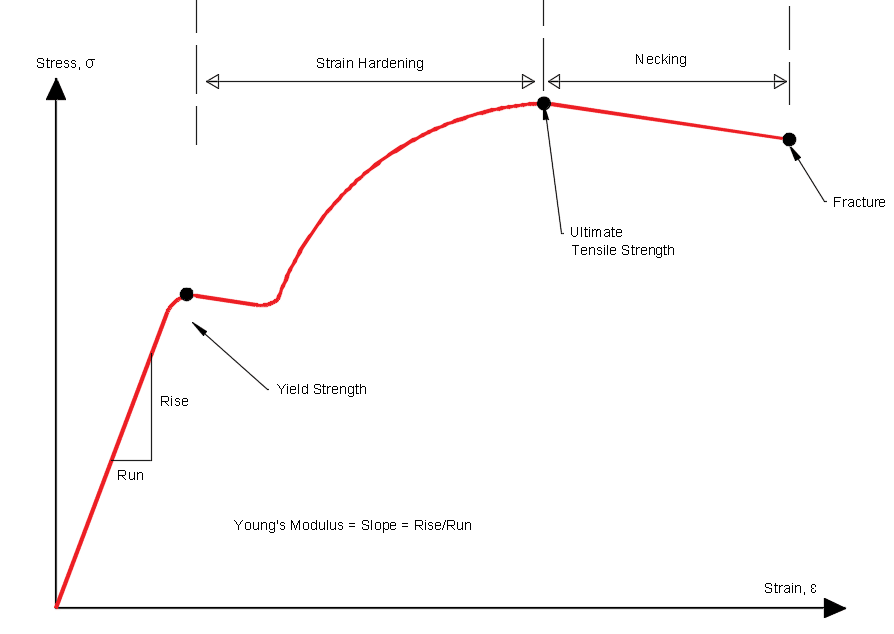
The Modulus of Elasticity, often shortened to just E (because scientists love their shorthand!), tells us how much a material will deform (bend or stretch) when you push or pull on it. It’s basically a measure of its stiffness.
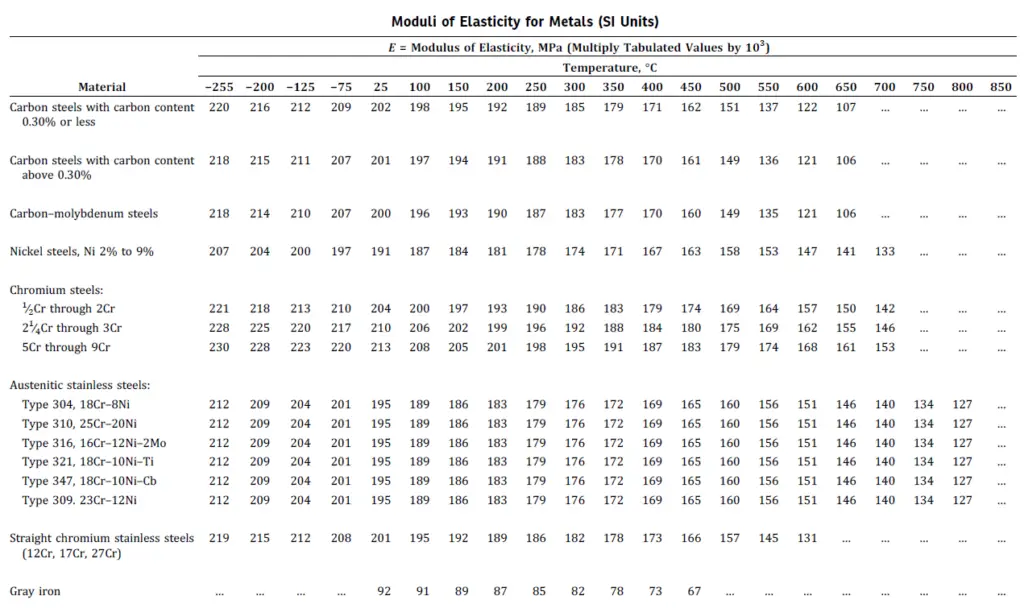
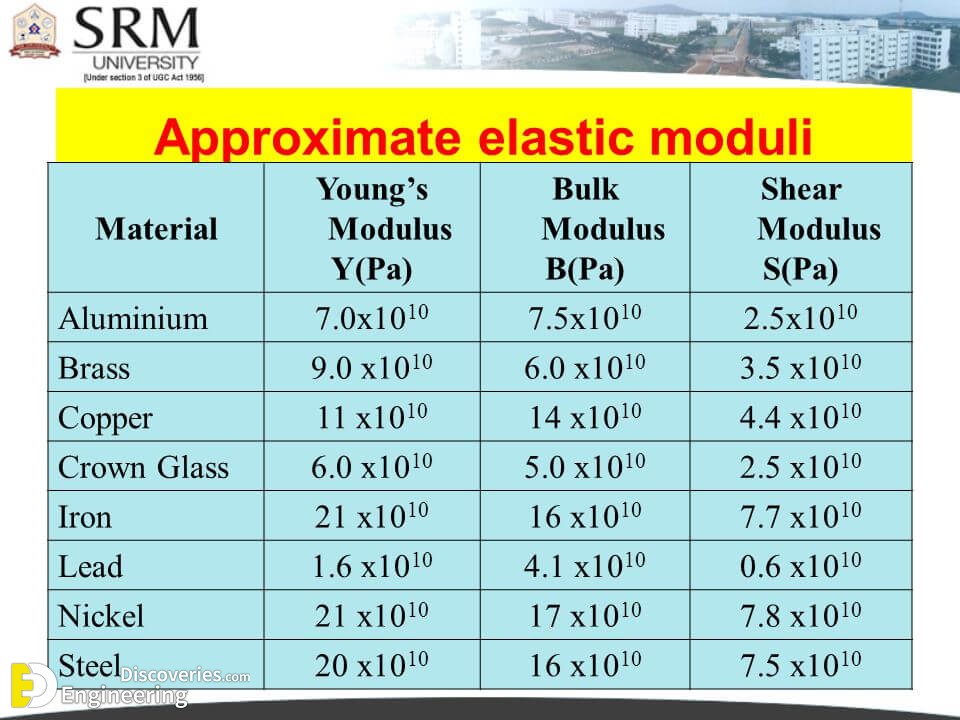
For steel, this number is pretty darn impressive. It's around 200 gigapascals (GPa). Now, don't let that number scare you. We’ll get to what it means in a sec without making your brain feel like it’s been put through a metal press!
Think of gigapascals as a super-duper unit of "oomph." It’s how much force you need to apply to get a certain amount of squishiness. For steel, it means you need a lot of force to make it bend even a tiny bit.
This is why steel is used for so many things. It’s the backbone of our modern world. From the tiny screws in your eyeglasses to the massive girders in bridges, steel’s reliable stiffness is a constant.
The Steel "Spring" Analogy
Let’s go back to that rubber band. If you stretch a thin rubber band, it might snap. If you stretch a thick, industrial-grade rubber band, it’s much harder to stretch, and it has a more powerful snap-back.
Steel is like that super-strong, industrial-grade rubber band, but it’s also incredibly tough. It’s designed to take a beating and bounce back. It doesn’t want to permanently change its shape easily.
The Modulus of Elasticity for steel means that even under immense pressure, it will only deform a little. And, crucially, when that pressure is released, it springs right back. This is the magic of elasticity.
This "springiness" is super important. It’s what allows buildings to absorb the shock of earthquakes. Without it, the entire structure would likely buckle and fail.
It’s also why your car can handle potholes. The steel frame absorbs the impact, deforms slightly, and then returns to its original shape. You might feel a bump, but the car itself is okay.
Why is Steel So Good at This?
Steel is an alloy, primarily made of iron and carbon. It's the way these atoms are arranged, packed together in a crystal lattice, that gives steel its amazing properties. Think of it like a meticulously built LEGO structure.
When you apply force, the atoms in the steel crystal are pushed and pulled against each other. For steel, these atomic bonds are really strong and have a specific way of resisting permanent deformation. It’s like the LEGO bricks are designed to snap back into place.
The Modulus of Elasticity is a direct reflection of how strong those atomic "snap-backs" are. Higher E means stronger atomic bonds and more resistance to permanent bending.

A Little Bit of History and Humor
Imagine the early days of engineering. Builders were using wood, stone, and then, eventually, iron. They learned through trial and error, and probably a few spectacular failures, about the strengths and weaknesses of different materials.
When steel started becoming more accessible, it was a game-changer. It was stronger, more flexible, and more reliable than anything that came before. Engineers were probably overjoyed, like kids getting a brand-new, super-powered toy.
The concept of the Modulus of Elasticity became a way to quantify this amazing property. Scientists like Thomas Young and later engineers developed the mathematical models to describe it. It was like finally putting a number on how "awesome" steel was.
This scientific understanding allowed for more ambitious designs. Instead of just building things that might stand up, engineers could design things with confidence, knowing exactly how much stress their steel could handle.
Steel’s Everyday Heroes
Think about your favorite mug. If it has a metal handle, that handle is likely made of steel. When you pick it up, it doesn't droop. That's steel's Modulus of Elasticity at work.
Or consider the playground! The slides, the swing sets, the climbing frames – all made of steel. They withstand the constant pushing, pulling, and bouncing of countless children.
It’s a silent testament to the strength and resilience of this incredible material. It’s the unseen force that keeps so much of our world in shape.
Even in the kitchen, your stainless steel pots and pans benefit from this property. They hold their shape, even when heated and cooled repeatedly. They don't warp easily, thanks to steel's high Modulus of Elasticity.
So, the next time you lean on a metal railing, or admire a bridge, or even just enjoy your morning coffee, take a moment to appreciate the humble steel. And remember its superpower: the incredible ability to bend a little, but always, always spring back.
The Modulus of Elasticity might sound complicated, but it's really just the science behind steel's dependable strength and resilience. It’s what makes steel not just strong, but also wonderfully, reliably springy. It’s a property that shapes our world in ways we often take for granted, but absolutely couldn't live without.