
What's At The Edge Of The Universe

Alright, gather 'round, folks, grab your lattes, and let's talk about something that's truly mind-boggling: the edge of the universe. Yeah, you heard me. The edge. As if the universe wasn't big enough already, we’re talking about its potential boundary. Sounds like something out of a sci-fi flick, right? But trust me, the real deal is way weirder, and probably more confusing, than anything Hollywood can cook up. Think less T-Rex in space, more… well, that’s the million-dollar question, isn’t it?
So, imagine you’re on a road trip, right? You’re driving, driving, driving, and you’re expecting to hit, I don’t know, the state line? A giant “Welcome to Ohio!” sign? But what if, instead of a sign, the road just… kept going? Forever? That’s kind of the first hurdle we hit when thinking about the edge of the universe. Most scientists are leaning towards the idea that the universe might not have an edge in the traditional sense. Nope, no giant cosmic “Do Not Enter” sign. No cliff you can fall off of. It’s more like an endless, expanding balloon. You can travel in any direction, and you’ll never bump into a wall. Pretty anticlimactic, I know. I was kind of hoping for a giant space donut or something equally delicious at the edge. A little snack for the cosmic traveler.
But hold on, before you start picturing infinite pizza slices stretching out forever, let’s get a little more… scientific. Or at least, as scientific as we can get while still being able to laugh at ourselves. The prevailing theory is that the universe is infinite and expanding. That means it’s literally getting bigger, all the time. Like a toddler on a sugar rush, but on a scale that makes your brain do a little flip. And if it’s infinite, then by definition, there’s no edge to find. It’s like asking where the end of the number line is. You can always add one, right? The universe is doing that, but with space itself.
Now, you might be thinking, “But wait, I’ve heard about the observable universe. Isn’t that like an edge?” And you, my friend, are a sharp cookie! You are absolutely right. We can talk about the observable universe. Think of it as the part of the universe that we, here on Earth, can see. It’s like being in a really, really, really big, dark room. You can only see as far as your flashlight beam reaches. That flashlight beam is the speed of light, and the universe has been around for about 13.8 billion years. So, we can only see things that have had enough time for their light to travel to us. That’s our cosmic horizon.
So, what’s beyond our observable universe? The honest, albeit slightly unsatisfying, answer is: we don’t know for sure. But the cool part is, the stuff out there is probably just more universe. More galaxies, more stars, more planets, more… well, more whatever you can imagine. It’s just that the light from that stuff hasn’t had enough time to get to us yet. So, it’s not that there’s a cosmic void, or a giant alien bouncer saying “No admittance,” it’s just that the universe is so darn big, and we’re so relatively young, that we haven’t caught up yet. It’s like showing up late to a party – everyone else has been there for ages, and you’re just catching the tail end of the conversation. Except this party is 13.8 billion years long.
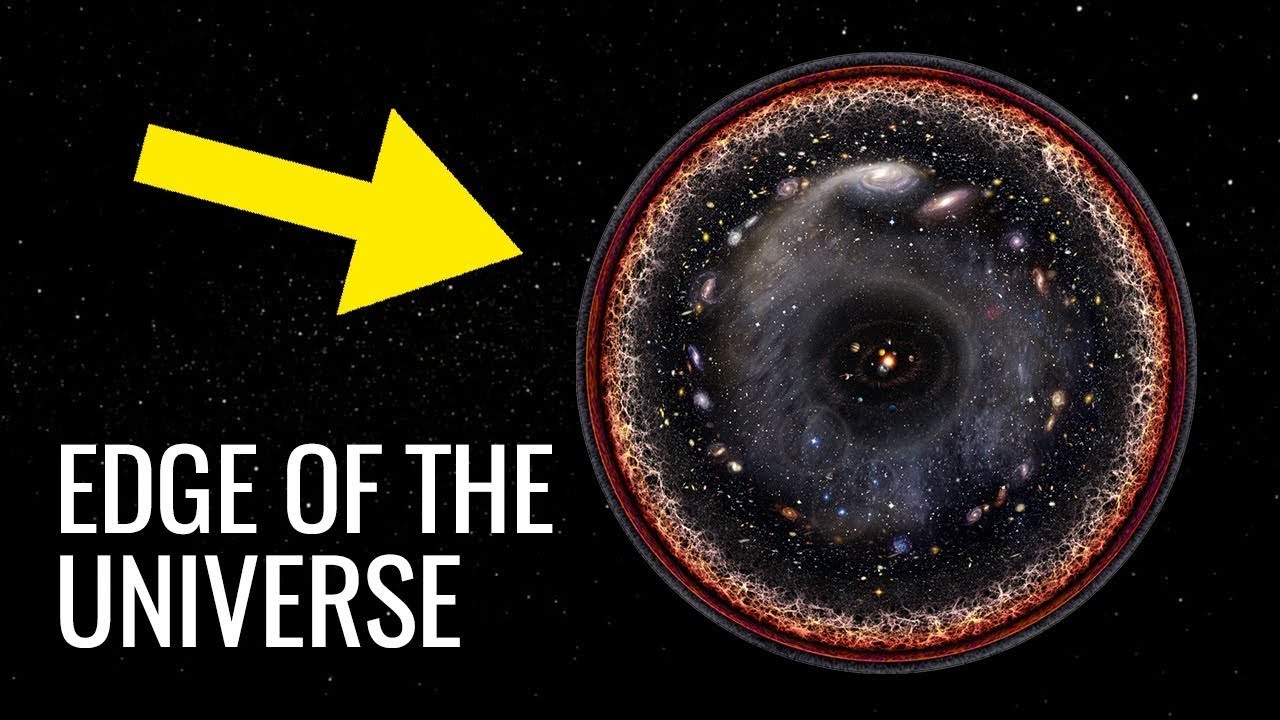
Here's a fun little fact to blow your mind: because the universe is expanding, the things we can see at the very edge of our observable universe are actually moving away from us faster than the speed of light! Sounds impossible, right? Like a cosmic cheat code? But it’s not the objects themselves breaking the speed limit. It’s the space between us and them that’s stretching so fast. Think of it like being on a treadmill that’s speeding up. You’re running, but the belt is just getting longer and longer underneath you, so you’re not actually moving on the belt any faster. Confusing? Good. That means you’re paying attention.
Some theories even suggest that the universe might be curved, like the surface of a sphere. If that’s the case, and you traveled in a straight line long enough, you’d eventually end up right back where you started. Imagine flying a spaceship around and ending up back at your own doorstep. You’d be like, “Whoa, that was a long commute!” This is called a closed universe. But then there’s the flat universe theory, where it just keeps going and going. And the saddle-shaped universe, which is… well, it’s a bit like a saddle. Imagine a cosmic horse, but without the horse. Just the saddle. Honestly, the math for this stuff gets so wild, it makes quantum physics look like kindergarten finger painting.

So, what's the takeaway here?
Essentially, if the universe is infinite, there’s no edge. If it’s finite but unbounded (like our sphere analogy), there’s still no edge you can reach. And if we’re talking about the observable universe, the “edge” is just the limit of what we can see, a boundary that’s constantly being pushed back as time marches on and light travels. It’s less a physical barrier and more of a cosmic informational horizon.
It’s important to remember that our understanding of the universe is constantly evolving. What we think today might be completely overturned by a new discovery tomorrow. Scientists are like cosmic detectives, piecing together clues from ancient starlight and the faint echoes of the Big Bang. And sometimes, they come back with answers that are more mind-bending than any detective novel. So, while we might not have a definitive “edge of the universe” to point to with a giant cosmic arrow, the questions themselves are what make it all so incredibly fascinating. It’s the grandest mystery, and the best part is, we’re all a part of it, floating on this little blue marble, staring up at the endless, expanding, and utterly mysterious cosmos. Now, who’s up for another coffee? My brain needs a recharge after all this cosmic pondering.