
Where Are Transition Metals Located On The Periodic Table
Ever looked at the periodic table and wondered about that big, colorful block smack in the middle? It’s like the VIP section, filled with elements that are a little bit wild, a little bit wonderful, and absolutely crucial to our modern world. These are the transition metals, and understanding where they hang out is like unlocking a secret code to understanding everything from the vibrant colors in your paint to the electronics in your pocket.
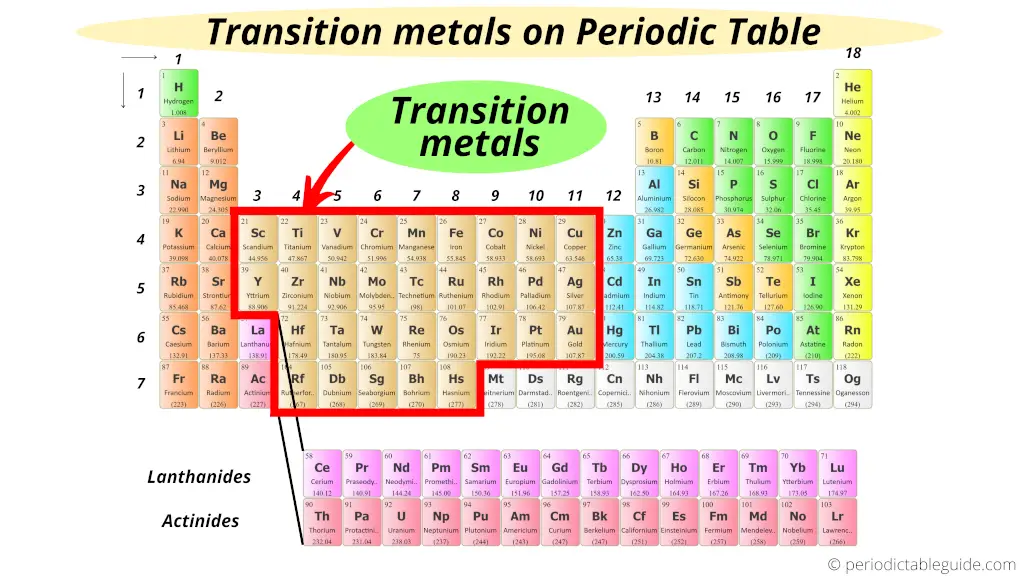
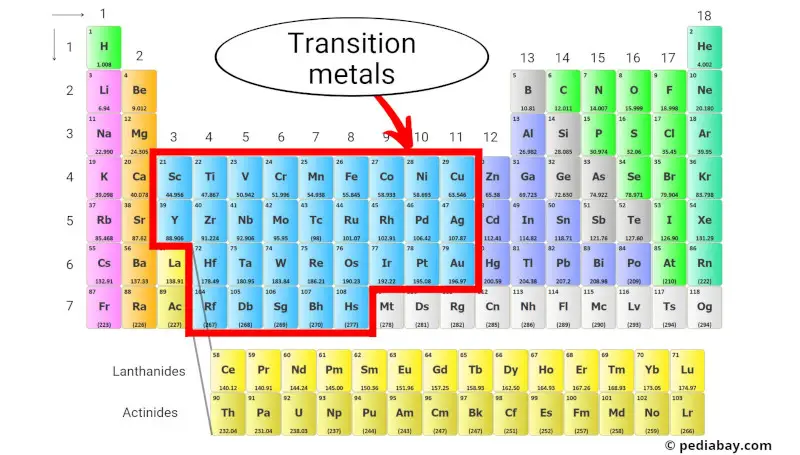
So, where do these fascinating elements call home on the periodic table? Think of the periodic table as a giant, organized neighborhood for all the known elements. Most of the elements are grouped into families based on their similar properties. You have the Alkali Metals on the far left, famously reactive and eager to give away an electron. Over on the right, you have the Noble Gases, aloof and content with their full outer electron shells. And then, right there in the center, is the sprawling, often brightly colored, region of the transition metals. They occupy what's usually colored a different shade, often a block of ten columns wide, starting from the fourth row (period) downwards.
This central block is formally known as the d-block of the periodic table. Why the d-block? It's all about their electron configurations. Unlike the elements on the sides, whose outermost electrons are in s or p orbitals, the transition metals are characterized by their partially filled d orbitals. This is the secret sauce that gives them their unique and versatile personalities!
Let's pinpoint their exact location. The periodic table is organized into rows called periods and columns called groups. Transition metals generally start in Period 4. So, if you’re looking at a periodic table, find the fourth row from the top. Now, look for the elements that are not in the first two columns (that’s where you’d find Potassium (K) and Calcium (Ca)) and not in the last six columns (those are the main group elements like Gallium (Ga) and Germanium (Ge)). Everything in between, those ten columns in the middle of Period 4 and extending all the way down to Period 7, that’s the land of the transition metals.
The specific groups they inhabit are typically numbered 3 through 12. So, you’re looking at the elements starting with Scandium (Sc) and Titanium (Ti) in Period 4, and going all the way across to Zinc (Zn) and Cadmium (Cd). This pattern continues down through Period 5 (starting with Yttrium (Y), moving across to Mercury (Hg)), Period 6 (starting with Lanthanum (La), though the Lanthanides are usually pulled out below, and ending with Copernicium (Cn)), and Period 7 (starting with Actinium (Ac), again with the Actinides usually below, and ending with Roentgenium (Rg)).
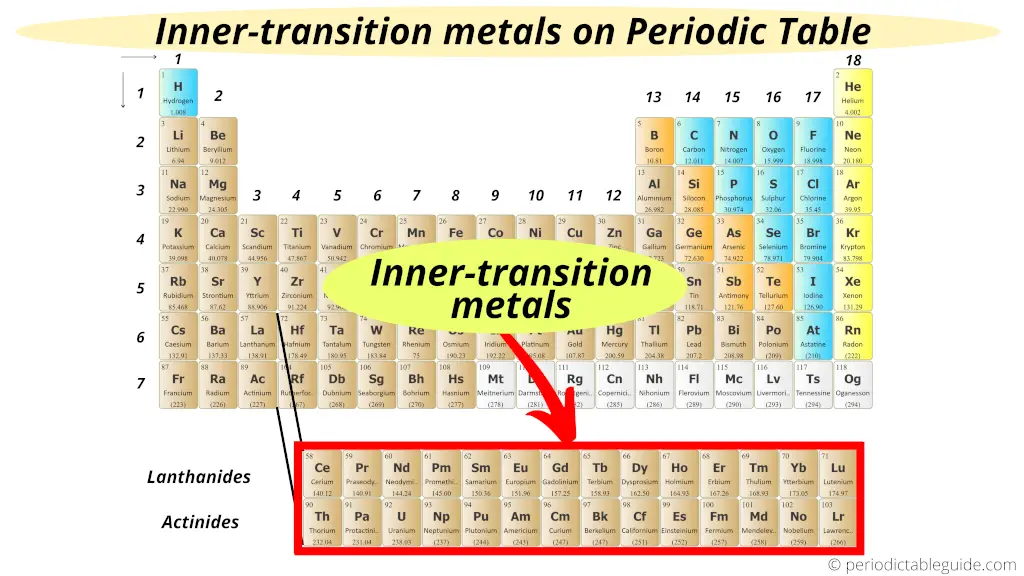
But wait, what about those two rows that are often pulled out and placed at the very bottom of the periodic table? Those are the Lanthanides (starting with Lanthanum (La) and going up to Lutetium (Lu)) and the Actinides (starting with Actinium (Ac) and going up to Lawrencium (Lr)). These are so special, and have such unique electron configurations (related to their f orbitals, not d orbitals), that they get their own little spotlight down below. They are sometimes called the inner transition metals, and they are, in essence, a continuation of the transition metal story, just a bit further down the family tree.
So, why is knowing this so cool? Well, these metals are the workhorses of industry and technology. Think about Iron (Fe), the backbone of construction and tools. Then there's Copper (Cu), essential for electrical wiring. Gold (Au) and Silver (Ag)? Beyond their bling factor, they're vital in electronics due to their conductivity. Chromium (Cr) gives stainless steel its shine and rust resistance. Nickel (Ni) is used in batteries and alloys. Even the elements you might not immediately recognize, like Platinum (Pt), are critical in catalysts for cars and in jewelry.
The reason for their widespread usefulness lies in those partially filled d orbitals. This allows transition metals to do some pretty amazing things:
-
Form Multiple Oxidation States: Unlike many main group elements that have a single, preferred "charge," transition metals can often exist in several different ionic forms. This makes them excellent catalysts, helping reactions happen faster without being used up themselves. Think of how a catalyst makes your car's engine run cleaner!
-
Form Colored Compounds: Many transition metal ions have vibrant colors. This is directly related to the energy levels within their d orbitals. When light shines on them, electrons can absorb specific wavelengths, and we see the remaining colors. This is why pigments in paints and dyes often come from transition metals like iron oxide (red/brown), chromium compounds (green/yellow), or cobalt compounds (blue).
 Periodic Table Charges Transition Metals | Cabinets Matttroy
 -
Form Complex Ions: They can easily bond with other molecules or ions, forming intricate structures called complex ions. This is important in biological systems, like hemoglobin in our blood which contains iron, and in industrial processes.
-
Paramagnetism: Many transition metals exhibit magnetic properties because they have unpaired electrons in their d orbitals. This is key for technologies like magnetic storage and MRI machines.
So, the next time you see a periodic table, don't just see a chart of elements. See the bustling, vibrant neighborhood of the transition metals. They're the central characters in the story of matter, responsible for so much of the color, strength, and technology that shapes our everyday lives. They are the glue that holds many of our modern marvels together, the artists who paint our world, and the powerhouses behind countless industries. They are, quite literally, the heart of the periodic table!