
Where In The World Is Carmen Sandiego Ms Dos

Remember those days? When your biggest worry was whether you'd remember to write down the correct password for your favorite DOS game? No cloud saves, no auto-updates, just pure, unadulterated digital adventure. For a generation of gamers, that era is synonymous with one name, one iconic red hat, and one burning question: Where in the World is Carmen Sandiego?
Ah, Carmen. She wasn't your typical villain. More of an international art thief extraordinaire than a world-domineering megalomaniac. Her missions were less about global destruction and more about, well, lifting priceless artifacts from museums and galleries across the globe. And you, the intrepid Gumshoe, were tasked with tracking her down.
This wasn't just any game; it was a stealthy education disguised as entertainment. Think about it: to catch Carmen, you had to become a veritable globetrotter, albeit a virtual one. You’d pore over digitized atlases, study the nuances of different cultures, and learn about historical landmarks, all in pursuit of that elusive crimson coat.
The DOS version, released back in the late 80s and early 90s, was a masterpiece of its time. It was clunky by today's standards, sure. The graphics were pixelated, the sound effects were… distinctive, and loading times felt like geological epochs. But oh, the charm! The sheer intellectual satisfaction of piecing together clues and finally issuing that warrant.
The Gumshoe's Toolkit: More Than Just a Magnifying Glass
Your primary weapon in the fight against Carmen’s pilfering ways was your ACME Detective Agency toolkit. This wasn't about advanced weaponry; it was about information. You'd receive intel – a note left behind, a witness description, a hastily scribbled itinerary – and it was up to you to decipher it.
This meant consulting your trusty World Almanac and Book of Facts. Remember that? A thick, imposing tome that became your digital bible. You’d flip through pages, cross-referencing geographical data, historical tidbits, and cultural insights. It was like having a cheat sheet to the entire planet.

The beauty of it was the organic learning. You weren't being force-fed facts. You were actively seeking them out because they were essential to your mission. Did Carmen steal the Rosetta Stone? You'd need to know where Egypt is, its capital, and perhaps even some basic hieroglyphic knowledge. Was she after the Mona Lisa? Prepare for a virtual trip to the Louvre in Paris.
This game taught us about things like:
- Capitals of countries: A fundamental building block of geographical knowledge. Who knew Luxembourg City could be so crucial?
- National flags: Recognizing a flag could mean the difference between chasing a lead to Canada or Chile.
- Famous landmarks: From the Eiffel Tower to the Great Wall of China, Carmen took us everywhere.
- Cultural customs and languages: Sometimes, a suspect might mention a particular dish or a greeting in a foreign tongue, forcing you to consult your almanac for clues.
It was a gentle nudge towards a wider world, an invitation to be curious. And the best part? It was accessible. The DOS version, with its relatively low system requirements, meant that many of us could experience this global chase right from our beige desktop computers. It was the OG way to 'travel the world' without leaving your room.
The Villains: A Rogues' Gallery of the Absurd
Carmen Sandiego's gang was a colorful bunch, each with their own quirky specialties. You had the likes of Lee "The Chameleon" Squared, who could blend into any environment, and Patty "The Paper Airplane" Paper Airplane, whose penchant for aviation was as obvious as her name. Then there was the infamous Tut "The Mummy" Thing, whose presence usually meant a trip to an ancient Egyptian tomb.

These henchmen weren't just random obstacles; they often provided vital clues. Their silly names and exaggerated personalities made them memorable, and their activities often hinted at Carmen's next move. It was a narrative woven into the gameplay, making each chase feel like a mini-detective novel.
The humor was also a significant part of the appeal. The game didn't take itself too seriously. There were often witty remarks from ACME agents and even from Carmen herself, adding a layer of lightheartedness to the pursuit. It was a refreshing contrast to the often grim and violent games that were starting to emerge in the same era.
The Art of the Clue: Decoding Carmen's Trail
Catching Carmen was a game of deduction. You'd receive a clue, perhaps a cryptic message like, "The thief was seen boarding a flight bound for the land of the maple leaf, carrying a stolen Fabergé egg." Your brain would immediately go into overdrive.
"Maple leaf?" That's Canada, obviously. But where in Canada? This is where the almanac came in. You'd scan the Canadian section, looking for cities, perhaps looking for which cities were major international airports. Was the stolen item a clue? Did the thief have any known associates in a particular region? Every detail mattered.

Sometimes the clues were more abstract. A witness might say, "He was humming a tune about a river that flows through a continent known for its tango." This would send you scrambling to your almanac, searching for major rivers and countries famous for tango (Argentina, anyone?). It was a delightful mental workout.
The satisfaction of finally cracking a complex clue was immense. It was that feeling of, "Aha! I've got it!" And then, with a click of your mouse (or a tap of your arrow keys), you'd dispatch your warrant to the correct location. The anticipation as the game loaded the next screen, hoping you were right, was palpable.
Beyond the Screen: The Legacy of Carmen Sandiego
Carmen Sandiego wasn't just a game; it was a phenomenon. It spawned television shows, books, and countless imitators. It proved that educational content could be genuinely fun and engaging. It showed parents and educators that video games could be more than just a time-waster; they could be a valuable learning tool.
The impact of Carmen Sandiego on a generation is undeniable. Many who played it fondly recall their childhood adventures, the hours spent poring over the almanac, and the thrill of outsmarting a fictional criminal mastermind. It instilled a sense of curiosity about the world and a belief that knowledge is power.
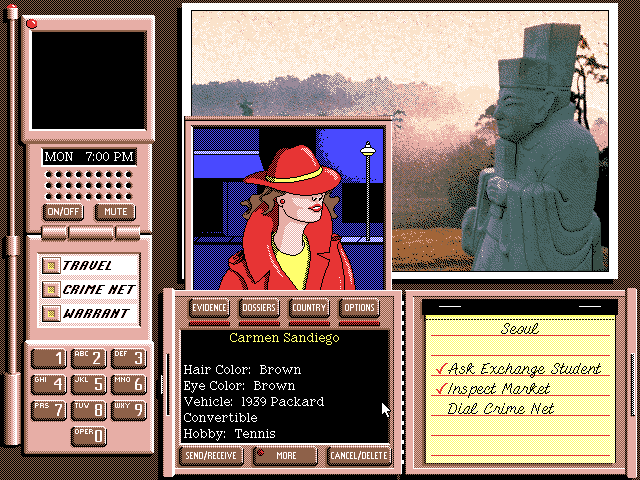
Think about the modern equivalent. We have apps for everything, instant access to information. But there’s a certain charm, a certain tactile satisfaction, in the deliberate act of flipping through pages, in the slow burn of discovery that the DOS version offered.
Practical Tips for the Modern Gumshoe (Inspired by Carmen)
While we may not be chasing down virtual jewel thieves on our DOS machines anymore, the spirit of Carmen Sandiego can still be applied to our daily lives. Here are a few tips:
- Embrace curiosity: When you encounter something new, don't just gloss over it. Ask questions. Look it up. Be like a Gumshoe, always seeking more information.
- Make learning an adventure: Whether it's learning a new skill or exploring a new topic, try to frame it as a fun challenge, not a chore. Can you make a game out of it?
- Connect the dots: In a world of information overload, the ability to synthesize different pieces of information is crucial. Practice looking for patterns and relationships between seemingly unrelated facts.
- Appreciate the analog: Sometimes, stepping away from the screens and engaging with physical objects – like a good book or a map – can be incredibly rewarding. It slows down the process and allows for deeper immersion.
- Never underestimate a good almanac (or its modern equivalent): Keep a go-to resource for facts and trivia. Whether it's a physical encyclopedia, a favorite website, or a trusted app, having accessible information is key.
Remember that feeling of accomplishment when you finally caught Carmen? That's the same feeling you get when you solve a difficult problem at work, learn a new recipe, or understand a complex concept. It’s the reward of engaging with the world around you, of actively seeking knowledge, and of using your brain to its fullest potential.
A Short Reflection
In our hyper-connected, instant-gratification world, the slow-burn, deliberate nature of games like Where in the World is Carmen Sandiego? on DOS might seem quaint. But there's a profound lesson embedded in its pixelated charm. It reminds us that true understanding often comes from the journey, not just the destination. It encourages us to be active participants in our own learning, to be detectives in our own lives, piecing together clues, exploring the unknown, and ultimately, discovering the vast, fascinating world that lies beyond our immediate grasp. So, the next time you’re faced with a puzzle, big or small, channel your inner Gumshoe. The world is full of Carmen Sandiegos, waiting to be caught, and a universe of knowledge waiting to be uncovered.