
Which Quality Of Ancient Greek Monsters Does The Cyclops Have
We all love a good monster story, right? They’re scary, they’re exciting, and sometimes, they’re just plain weird. Ancient Greece was absolutely bursting with incredible monsters – think of the many-headed Hydra or the terrifying Medusa with her snake hair. But among all these fantastical beasts, there’s one that always stands out for its rather… unique feature: the Cyclops!
Now, when you hear "Cyclops," what's the first thing that pops into your head? Probably that giant, one-eyed dude, right? And you're spot on! But what kind of quality from the ancient Greek monster playbook does our single-eyed friend really embody? It's not just about having one eye; it's about what that single eye, and the creature itself, represents.
Let’s think about the general vibe of ancient Greek monsters. They were often forces of nature, wild and untamed. They were the things that humanity feared in the dark forests or the roaring seas. They could be incredibly strong, like the mighty Minotaur, or possess deadly magic, like the aforementioned Medusa. They were the challenges heroes had to overcome to prove their bravery and cleverness.
And where does the Cyclops fit in? Well, the most famous Cyclops, of course, is Polyphemus, the one Odysseus famously outsmarted. Polyphemus wasn't just a giant with one eye; he was also a shepherd. He lived in a cave, making cheese and tending his sheep. This is where things get interesting. He’s not some ethereal spirit of the underworld or a creature born of pure chaos. He’s… surprisingly domestic, in a terrifying, giant sort of way.
This is a quality that many ancient Greek monsters share: they often have a connection to the more primal, untamed aspects of the world, but they also have a tangible, almost mundane existence. They're not just abstract evil; they are creatures that eat, sleep, and have routines. The Cyclops, in his cave with his flock, is a perfect example of this. He represents the wild, powerful force that exists outside of human civilization and its rules, but he does it in a way that feels incredibly real.
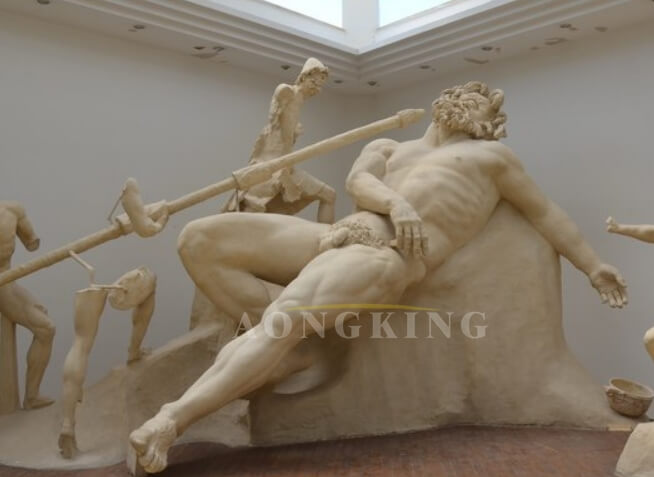
Think about it: Odysseus doesn't just stumble upon a shapeless terror. He finds a cave. He sees cheese. He sees sheep. This grounds the monstrous in the everyday, making the eventual confrontation all the more stark. It’s like finding a wolf pack living in your backyard shed – terrifying, but also strangely familiar in its setting.
Another quality that the Cyclops shares with many of his monstrous brethren is a certain lack of sophistication. While some monsters might be cunning and manipulative (looking at you, Scylla and Charybdis!), the Cyclops, particularly Polyphemus, is often depicted as rather straightforward, even a bit dim. He’s strong, he’s hungry, and he has a simple plan: eat the invaders.

This is where the humor often creeps in. Odysseus doesn't defeat Polyphemus with brute force. He uses his wits, tricks the Cyclops into getting drunk, and then blinds him with a sharpened stake. It's a classic tale of brains over brawn, a theme that runs through many Greek myths. The monster's sheer power is met by human ingenuity, and the giant, all-powerful Cyclops is brought down by a clever trick and a bit of "Nobody". It’s almost heartwarming, in a way, to see the underdog win!
"The Cyclops is a magnificent example of the ancient Greek monster's capacity for being both utterly terrifying and surprisingly simple, making them ripe for outsmarting."
So, what quality does the Cyclops embody from the grand tapestry of ancient Greek monsters? It’s the quality of being a primal force, a creature embodying the raw, untamed power of nature. But crucially, he’s also a creature with a tangible existence, a life that, however monstrous, has a routine and a place. He’s not just a vague threat; he’s a specific problem in a specific location. And because of his directness and often, his lack of cunning, he perfectly represents the ancient Greek monster’s vulnerability to human intelligence and courage. He’s the ultimate challenge that, when overcome, proves not just the hero's strength, but his smartness. And that's a quality we can all cheer for, even when facing a one-eyed giant!