
Which Side Of The Periodic Table Are Metals
Hey there, science curious friend! Ever looked at that colorful chart of elements, the Periodic Table, and wondered, "Okay, so where are all the shiny, bendy things?" You know, the stuff that makes your pots and pans, your jewelry, even your phone? Those are our amazing metals!
And guess what? They're not scattered randomly like glitter from a craft project gone wild. Nope, they have their own real estate on the Periodic Table. It's like a giant real estate map for atoms. So, let's spill the beans. Which side of this elemental city hosts the metallic party?
The Big Reveal: Left Side is Where It's At!
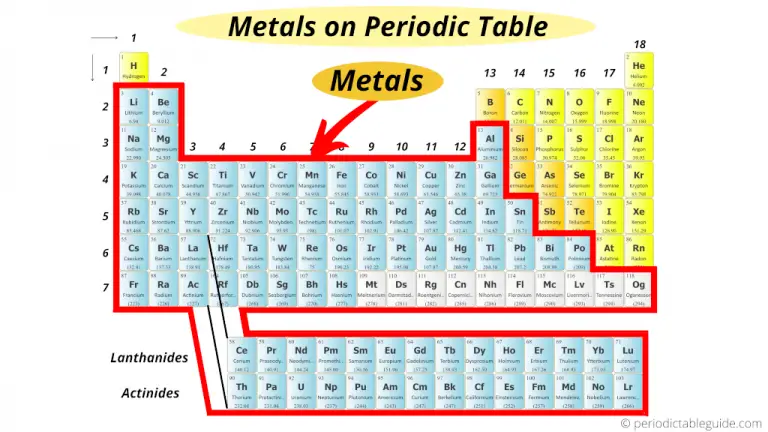
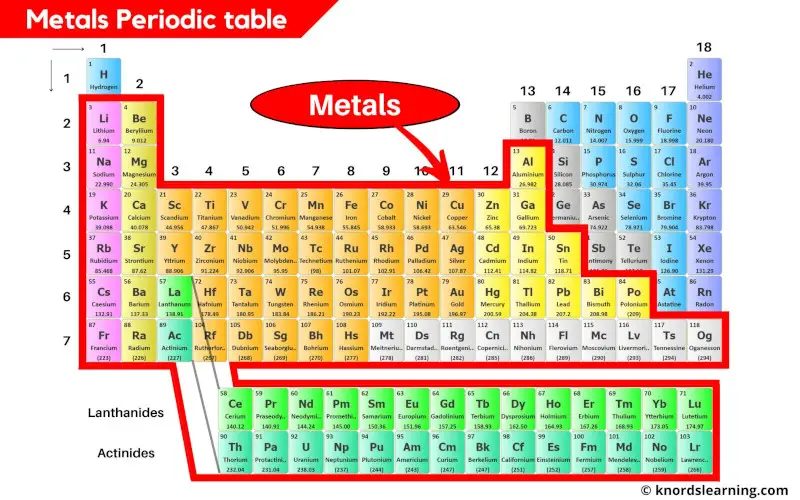
Drumroll please... Most metals hang out on the left side of the Periodic Table. Like, most of them. Think of the Periodic Table as a big rectangle. If you drew a jagged line down the middle, the elements to the left of that line are your metal MVPs.
Seriously, if you're looking for the bling, the banging, the bendy, the conductive – head left. It's like a VIP section for elements that are just… metallic. Super straightforward, right?
But Wait, There's More! (It's Not Just the Far Left)
Now, it's not just the absolute leftmost column. That's the alkali metals – super reactive, a bit wild. Think Sodium (Na) having a grand old time with water (spoiler: it explodes!). They're definitely metals, but they're a special breed.
As you move across to the right, but still on the left side of that imaginary line, you find more of your everyday metals. Things like Iron (Fe) holding up your bridges. Copper (Cu) conducting electricity in your wires. Gold (Au) looking fabulous and being incredibly unreactive (smart move, Gold!).
These guys are the workhorses. They're strong, they're useful, they're… well, metallic! They make up the bulk of the metallic population on our favorite elemental chart.

The "Staircase" Trick: Your Visual Cheat Sheet
So, how do you actually see this on the table? Look closely. The Periodic Table often has a subtle visual cue. There's a sort of "staircase" pattern that separates metals from nonmetals. This staircase is usually a bit darker or highlighted.
Elements to the left of this staircase? You guessed it: metals. Elements to the right? Those are your nonmetals. And then, bless their unique hearts, you have the metalloids hanging out right on the staircase itself. More on them later, they're the rebels of the periodic world!
Why is it Organized Like This Anyway?
This isn't just for fun, although it is fun. The Periodic Table is organized by atomic number and recurring chemical properties. Elements in the same column (group) tend to behave similarly. And guess what? All those metals on the left have similar metallic personalities.
They tend to lose electrons easily. This makes them good at forming positive ions. It's why they bond with other elements in predictable ways. It's all about their electron shells, folks. Fancy science talk for "they like to share their outer electrons in a specific way."

Quirky Facts That Make Metals Even Cooler
Let's talk about some fun stuff. Did you know that Mercury (Hg) is the only metal that's liquid at room temperature?
Imagine that! All other metals are solid. Mercury is like the goth of the metal world, chilling in liquid form. It’s found in old thermometers, but please don't play with it. It’s pretty toxic!
And then you have Cesium (Cs) and Gallium (Ga). These metals are so low-melting, they can melt in the palm of your hand! Imagine a metal spoon just… drooping. Slightly alarming, but also kinda cool, right?
Then there's Osmium (Os) and Iridium (Ir), the densest elements known. They're like the universe's tiny, super-heavy dumbbells. A sugar cube-sized piece would weigh as much as an elephant! Mind. Blown.

The "Nonmetals" Are Just Not As Shiny
So, what about the other side? Those are your nonmetals. Think Oxygen (O) you breathe, Carbon (C) in your body and pencils, Nitrogen (N) in the air. They're essential, vital, life-giving. But they’re generally duller. Literally. They don’t have that metallic luster. They're often gases or brittle solids.
They tend to gain or share electrons, which is the opposite of our metal buddies. It's like they have different social rules in the atomic world. They don’t bend; they often break. They don’t conduct electricity super well. They're just… different.
The Metalloids: The Border Crossers
Now, about those elements on the staircase? They’re called metalloids. They're the Switzerland of the Periodic Table. They have properties of both metals and nonmetals.
Silicon (Si), for instance. It’s a metalloid. It’s used in computer chips because it can conduct electricity, but not as well as a metal. It's like a dimmer switch for electricity. Super useful for our techy world! They’re the indecisive ones, the rebels, the best of both worlds!
Why is this "Metal" thing so important?
Because metals are everywhere! They build our world. They power our technology. They make our jewelry sparkle. Understanding where they live on the Periodic Table helps us understand their properties and how they behave.
It’s the first step to understanding chemistry, physics, and why the world around you is the way it is. It’s not just about memorizing names; it’s about understanding a fundamental organization of the universe.
So, Next Time You See the Table…
Just remember: left side is metal country. The further left you go, the more classically metallic the elements become. The staircase is your guide to the land of nonmetals and the cool, in-between metalloids.
It’s a bit like a treasure map for the elements. And the treasure? It’s understanding the building blocks of everything! Isn’t that just a fantastic thought? Happy element hunting!