
Why Did The Glaciers Miss The Driftless Area

Imagine this: the world is a giant ice cube tray, and the glaciers are these enormous, frosty spatulas determined to scrape every last bit of "normal" off the land. They’d scoop and scoop, leaving behind mountains of rubble and carving out valleys like you wouldn't believe. Think of them as the ultimate, albeit slow-moving, bulldozers of the ice age. They flattened plains, polished mountainsides, and generally made a mess of things for anything that wasn't ready for a good old-fashioned glacial makeover.
But then, there’s this one spot. This particular patch of land that, for reasons that still make geologists scratch their heads and whisper in hushed tones, seemed to be on the glacier's "do not disturb" list. We’re talking about the Driftless Area, a magical pocket of land nestled primarily in southwestern Wisconsin, southeastern Minnesota, northeastern Iowa, and a sliver of northwestern Illinois. And the reason it's so special? The glaciers, those magnificent, unstoppable ice behemoths, just… missed it. Yep, they sailed right on by, leaving this region looking like a time capsule from a pre-ice-age world.
Now, you might be thinking, "How could something so big, so powerful, just miss a whole chunk of land?" Well, picture yourself trying to navigate a crowded room carrying a giant, unwieldy platter of your grandma's famous Jell-O mold. You're trying your best to get to the table without spilling a single jiggly cube, but inevitably, you bump into things, you veer off course. Glaciers, while undeniably massive, weren't exactly graceful dancers. They were more like enormous, frozen rivers flowing downhill. And sometimes, the land itself seemed to say, "Nope, not today, frosty friends. You go around."
The prevailing theory is that the ancient topography of the Driftless Area played a starring role. Think of it like this: imagine the glaciers were big, flowing currents in a giant, icy ocean. If there were some really steep, rocky outcroppings, or a series of deep, winding valleys already in place, the ice might have found it easier to flow around them, like water finding its way around a boulder in a stream. These weren't just gentle slopes; these were probably some seriously rugged landscapes that made the glaciers say, "You know what? That looks like a lot of effort. I'll just take the scenic route over there."
It’s as if the land itself, with its rugged charm and ancient beauty, whispered a secret to the approaching ice: "You can't touch me!"
Where is the Driftless Area? | Mississippi Valley Conservancy
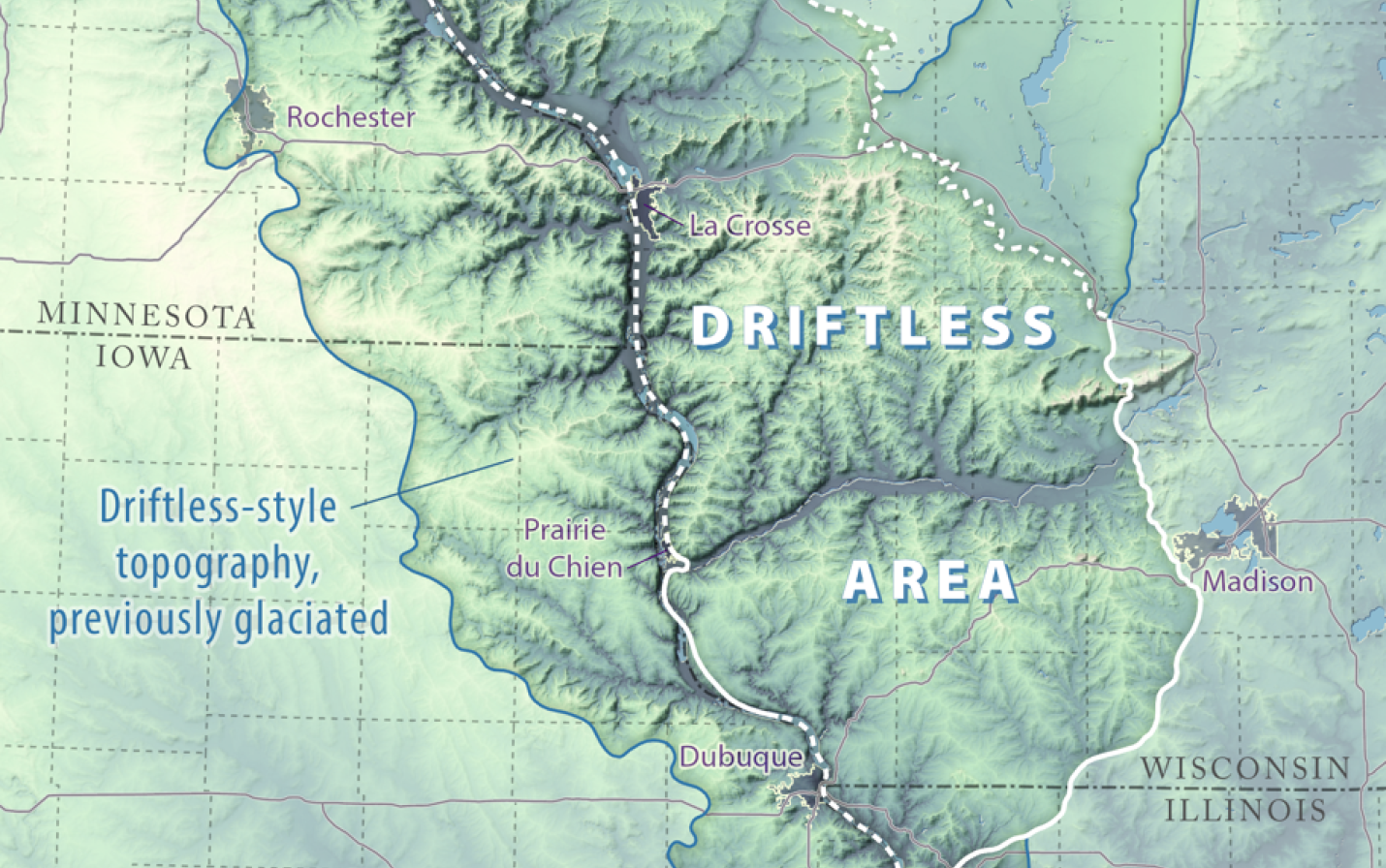
And so, while the surrounding areas were getting a thorough sanding and shaping from the ice, the Driftless Area was left to its own devices. The glaciers, with their immense power, were like the world’s most persistent gardeners, pruning and shaping everything. But the Driftless Area was like that one stubborn weed that just refused to be pulled. It retained its ancient hills, its steep bluffs, its winding river valleys. You can still see the evidence of this "miss" today. When you travel through this region, it just feels different. The landscape is a lot more dramatic, more varied, and honestly, a lot more interesting than the flatter, glaciated lands nearby. It’s like the difference between a meticulously manicured lawn and a wild, untamed forest – both have their beauty, but one has a certain raw, ancient magic.
The lack of glacial till, or "drift," is the literal proof in the pudding (or rather, the lack of pudding in the drift). Everywhere else, the glaciers left behind a thick blanket of debris – sand, gravel, rocks, you name it – all scraped from miles away. It's the stuff that makes up a lot of the soil and landscape in much of the Midwest. But in the Driftless Area, that deposit is remarkably absent. It’s as if the glaciers decided to pack their bags and leave their construction materials elsewhere. They were supposed to be the ultimate remodelers, but for this one precious corner of the earth, they just shrugged their icy shoulders and moved on.

Think of it this way: imagine you’re a kid with a huge box of LEGOs, and you're tasked with building a city. You build skyscrapers, highways, entire neighborhoods. But there's a small, oddly shaped plot of land in the middle of your building zone. Maybe it's too bumpy, maybe it's too close to the edge of the table. You just… build around it. You leave it be. The glaciers, in their own colossal way, did the same thing. They saw the rugged beauty of the Driftless Area and said, "You know what? This place is already pretty darn cool. Let's just admire it from afar."
And because of this incredible "miss," the Driftless Area is a treasure trove for nature lovers and geology buffs. The unglaciated landscape means that older rock formations are exposed, leading to stunning geological features like limestone bluffs, caves, and unique river systems. The soil, not being the pulverized leftovers of a glacial demolition derby, is also incredibly rich and fertile, leading to a vibrant agricultural history. It’s a place where you can hike along trails that haven't been smoothed over by millennia of ice, where you can explore caves that were carved out by water, not scraped by glaciers. It’s a testament to the fact that sometimes, what doesn't happen can be just as important as what does. The glaciers were the ultimate sculptors, but the Driftless Area? It was already a masterpiece, and they were wise enough, or perhaps just clumsy enough, to leave it that way. And for that, we are all incredibly grateful.